
Where sectional fails
At the joints, every time. The slip connector relies on a bead of sealant that expands and contracts with the metal through Missouri's temperature swing, and sealant loses that argument in five to ten years.
The failure isn't dramatic. It's a slow weep that stains the fascia, soaks the board, and shows up as rotted wood years before anyone traces it back to the joint.
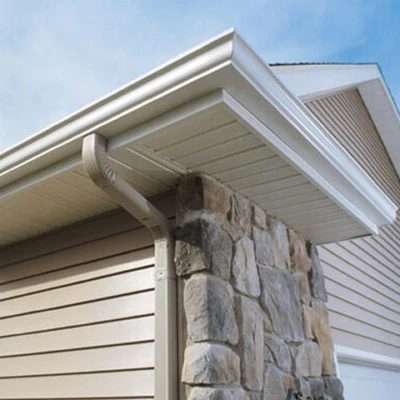
Where seamless still has joints
Corners and end caps. There's no way to form a corner out of a continuous run, so miters are cut, fitted and sealed.
The difference is that a corner is one point per elevation instead of one every ten feet, and a corner is easier to inspect and reseal when it eventually needs it.
Cost difference
Less than most people assume. Seamless material costs a bit more and the labor is comparable, because a roll-forming truck hangs a 40-foot run faster than a crew fitting four sections together.
Sectional's real advantage is that a homeowner can buy it at a store and install it themselves. That's a DIY advantage, not a performance one.
When sectional is fine
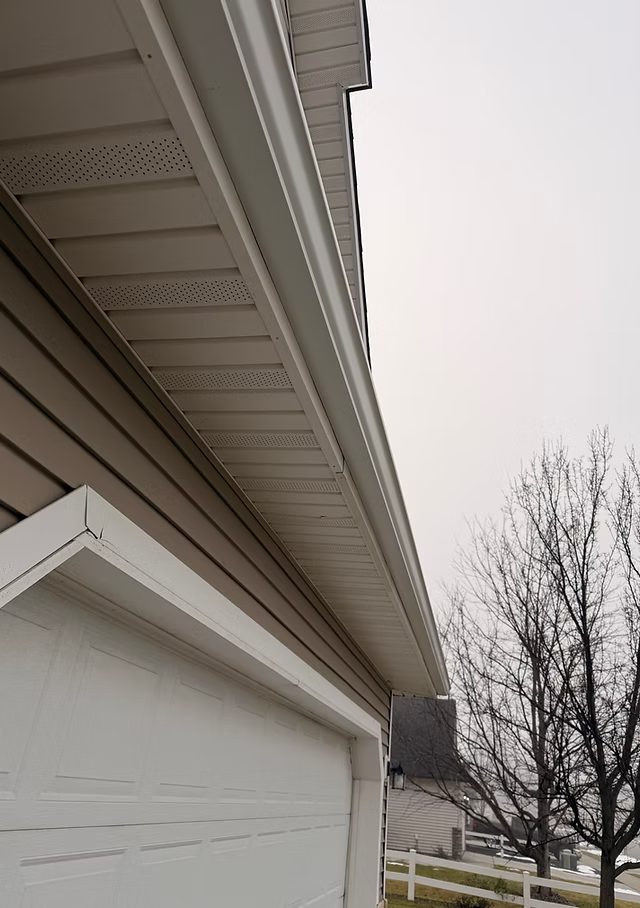
Short runs. A 12-foot garage or a small porch roof isn't going to have a joint in the middle of it either way.
Beyond that, if a contractor is proposing sectional on a full house in 2026, ask why.
Questions people ask
Is seamless gutter really better?
On any run longer than about 15 feet, yes. You're removing the failure points.
Does seamless gutter still leak?
At corners, eventually, like any system. Along the run, no — there's nothing to leak through.
Is seamless much more expensive?
Modestly. The labor is similar and the material premium is small relative to the job.
Can seamless gutter be repaired?
Yes. Sections can be cut out and new runs formed, corners resealed, hangers replaced.
Free estimate
We measure, we look at the fascia, and you get a number in writing.
Talk to a real St. Louis gutter company
Third generation, family-run since 1947. Somebody picks up, day or night.