
The hose test, top to bottom
Start at the ground. If the downspout ends in an elbow and a splash block, pull the bottom elbow off and look up the pipe. Daylight means it's clear. Darkness and a smell of wet leaves means you've found it.
If it goes into the ground, feed a hose into the top of the downspout at the gutter outlet and turn it on medium. Then go listen. Water gurgling down and disappearing is good. Water filling the gutter and spilling at the top tells you the outlet or an upper elbow is plugged.
Water that runs down fine for a minute and then backs up the downspout is the buried pipe. That's the one people don't want to hear about, but it's also the one that matters most for the basement.
The outlet at the top
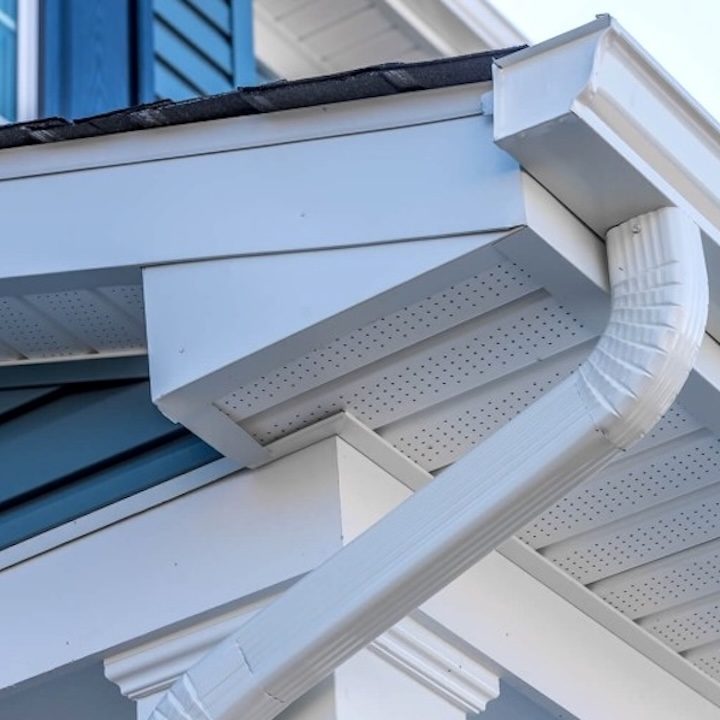
The hole in the bottom of the gutter where the downspout connects is the narrowest point in the whole system. Everything in the trough heads there. In late April the silver maples drop their seeds by the bucket, and they wedge into that opening like corks.
Oak tassels arrive a few weeks later and bind it all together. Shingle granules settle underneath and turn the mess into something close to mud. Clearing it by hand from a ladder takes a few minutes. Leaving it for a season means the gutter fills and spills in every storm.
Elbows catch what the outlet lets through
Most downspouts don't run straight. There's an offset near the top to kick the pipe in from the eave to the wall, and another elbow at the bottom to turn the water out into the yard. Each bend is a place for a clump of leaves to stop.
Tap along the downspout with a screwdriver handle. A clear pipe rings hollow. A packed one sounds dull right where the clog sits. Upper elbows can usually be cleared from the top with a plumber's snake or by taking the offset apart, and we'll reattach it with fresh screws so it doesn't sag afterward.
If clogs come back every few months, the outlet may be undersized for the roof above it. A 3x4 downspout carries noticeably more water than a 2x3 and is far harder to plug.
Buried pipe that quit years ago
Lots of St. Louis houses have downspouts tied into a pipe underground. Older homes may have clay tile lines. Houses from the last few decades usually have black corrugated plastic, the flexible ribbed kind. Both fail, just differently.
Clay tile cracks at the joints, and tree roots find the cracks. Corrugated pipe crushes under a mower or a car, and its ridges trap silt until the line is half full of dirt. Neither shows any sign from above until water starts backing up the downspout or bubbling out of the lawn a few feet away.
We run water through the line and see where it comes out, if anywhere. A drain camera settles the question when the hose test can't. Our downspout drainage solutions page lays out the replacement options once you know the line is done.
Clay soil changes the plan
Here's the honest part. Much of the St. Louis area sits on heavy clay that barely takes on water. A pop-up emitter at the end of a buried line only works if the pipe has somewhere lower to go. On a flat lot in the Metro East or a yard that slopes back toward the house, that lower spot may not exist.
In those cases a buried line just becomes an underground holding tank. Water sits in it, then seeps back toward the foundation. Sometimes the better answer is a longer extension above ground, or re-routing the downspout to a different corner where the grade falls away. We'd rather tell you that than dig a trench that won't drain.
Frozen solid in January
Freeze-thaw weather does a number on downspouts. Snow melts off the roof on a sunny afternoon, runs down the pipe, and freezes in the bottom elbow after dark. The next melt has nowhere to go. In a bad week the whole downspout can fill with ice, and a seam may split as it expands.
Usually the ice thaws on its own and everything works again. But a downspout that freezes every winter is often sitting in shade, or it's emptying into a buried line that holds water. Fixing the drainage below it tends to fix the freezing too. Our ice dams and gutters page covers the roof side of winter water.
Why this one's worth the trouble
A blocked downspout isn't just a gutter problem. Every bit of water it was supposed to carry away ends up spilling at the foundation. On clay, that water swells the soil, pushes on the walls, and finds its way into the basement. See basement flooding from gutters if you're already seeing it inside.

Where we'd hold back
We won't dig up a yard on a guess. If the hose test points at the outlet, we clear the outlet and stop there.
We won't put a new buried line into ground that has no place to drain it, even if you ask. It'll fail the same way the old one did, and you'll have paid twice.
And we won't tie a downspout into the street or a storm sewer without you checking with your city or county first. Some St. Louis municipalities allow it and some don't, and the rules aren't the same across the metro.
Downspout drainage questions
Is the clog in the downspout or in the pipe underground?
Pull the downspout loose just above the ground and run a hose in at the top. If water pours out freely at the bottom, the downspout is clear and the buried pipe is the problem. If it backs up before reaching the ground, the clog is in the downspout.
Why is water bubbling out of the lawn near the downspout?
The buried line is broken or crushed a few feet from the house, so water is escaping at the break. It's soaking the soil next to the foundation, which is the opposite of what the pipe was meant to do.
Can my downspout drain into the street?
Sometimes. Rules on connecting to a curb or storm sewer vary by city and county around St. Louis. Check with your municipality before anyone runs a line to the street.
Can a downspout freeze solid in a St. Louis winter?
Yes, especially the bottom elbow on a shady side of the house. It usually thaws by itself. If it happens every year, look at what the downspout empties into, because standing water below it is often the cause.
Will a bigger downspout stop the clogs?
It helps a lot. A 3x4 downspout has a much larger opening than a 2x3, so leaves and seeds pass through instead of jamming. It also carries more water off a large roof section.
Tell us where it backs up
Let us know if the downspout goes into the ground, whether water bubbles up in the yard, and when you first noticed it.
A St. Louis gutter company that tests before it digs
Family-run since 1947 and in our third generation. BBB A+, Owens Corning Platinum Preferred, lifetime workmanship warranty and free estimates, with phones answered 24/7.