
Watch it before anyone climbs a ladder
Grab an umbrella and stand where you can see the spill during a good rain. Not a drizzle. You want enough water moving that the gutter is working hard, because that's when the weak spot shows itself.
Look at three things. Is the water coming off the roof in a sheet or a rope? Is it pouring over the front lip, or curling over the back? And is the rest of that same gutter carrying water toward the downspout, or sitting still?
A rope of water off one area of shingles means a valley. A still, full trough with water lapping over a low edge means a sag or a clog. Water climbing out right where two runs meet means the corner. That's most of the diagnosis, done from the lawn.
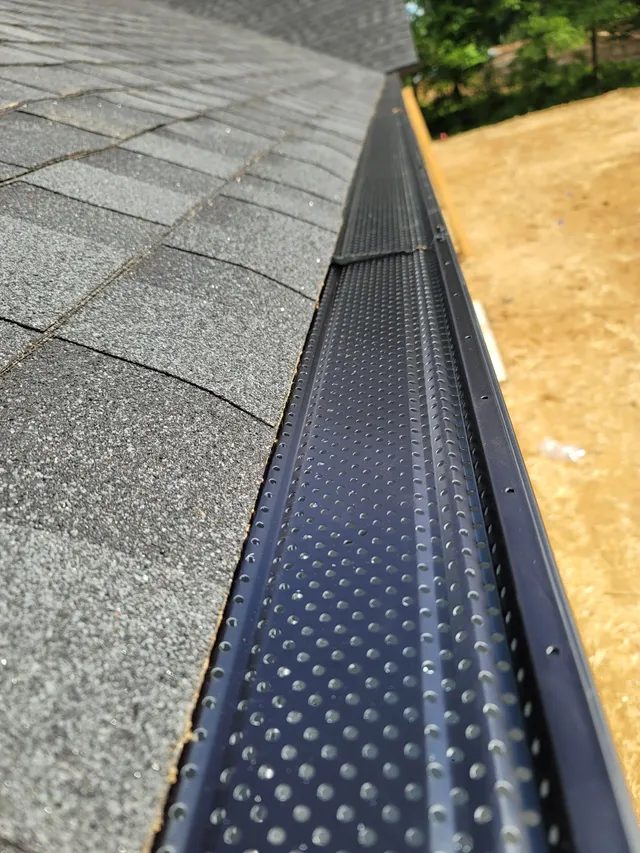
Valleys dump two roofs into one foot of gutter
A valley is the inside crease where two roof slopes meet. Every drop that lands on both of those slopes ends up running down that crease, picking up speed the whole way. At the bottom it hits the gutter like a hose turned on full, and on a steep roof it can shoot right across the trough and over the front edge.
The cheap fix comes first. A valley splash guard is a short piece of bent metal riveted to the outer lip of the gutter, standing up a few inches to catch that stream and knock it back into the trough. It's small. It works more often than people expect.
If the guard isn't enough, the next step is a downspout close to the valley, so that water has a short trip out. On a big two-story with a long valley, a wider 6-inch gutter on that one run can make sense. We'd only suggest it after the smaller fixes have been ruled out.
The belly between two hangers
Gutters hang from brackets or hidden hangers screwed into the fascia. When one of those lets go, or when they were spaced too far apart to begin with, the trough droops between them. Water collects in that low pocket. Leaves follow the water and settle there.
Pretty soon the pocket is full, and it spills. St. Louis winters make it worse every year. Water that sits in the dip freezes, thaws and freezes again, and a few hundred pounds of ice over a season pulls the sag a little deeper each time.
You can often see standing water in that stretch a day after the rain stops. The repair is rehanging the section with new hangers at closer spacing and resetting the slope. Our page on sagging gutters walks through the bigger version of this problem.
A plug sitting right above the outlet
Here's a pattern we see every May. Oak tassels come down in a wave, the stringy pollen catkins, and they mat together in the gutter like wet felt. They drift toward the downspout opening, and they stop there. The trough looks half clean from the ground, but the hole that matters is sealed.
Silver maple seeds do the same thing a few weeks earlier. The little helicopters stack up in the drop outlet and wedge themselves tight. Water then backs up and spills over at the low end, right next to the downspout.
Test it with a garden hose run into the gutter about ten feet upstream of the outlet. If the water pools and climbs instead of disappearing, the outlet or the first elbow is blocked. Our downspout not draining page covers what to do when the block is farther down.
Corners where two streams collide
An inside corner collects water from two directions. Both flows meet head-on, pile up, and the wave goes over the top. It's worse when there's no downspout near the corner and all that water has to turn ninety degrees and keep traveling.
Moving or adding a downspout at the corner usually ends it. If the drip is coming through the corner joint rather than over it, that's a different repair, and our page on a gutter dripping at the corner explains how to tell them apart.
Slope that runs uphill
A gutter needs a slight fall toward its downspout. Hung dead level, it drains slowly and holds a film of water and grit. Hung with the slope backwards, it sends the water to the closed end cap, and that end overflows every time.
Runs longer than about forty feet are usually pitched from the middle down to a downspout at each end. When a long run only has one, the far end ends up too low or the slope gets too steep to look right. Adding a second downspout fixes the geometry.
The dented spot on a newer build
Out in St. Charles County, plenty of houses built in the last fifteen years or so got .019 builder-grade aluminum. That gauge is thin. Lean a ladder against it once to clean the gutters and you'll leave a kink that drops the front lip half an inch. That kink becomes the overflow point.
Sometimes we can rehang and straighten it. Sometimes the metal is creased too badly. Because a run is one continuous piece, replacing the dented part means replacing that whole run in a heavier gauge, and we'll tell you straight whether it's worth doing now or can wait.
Pages that go deeper on each cause
Spills along the whole run
When the entire gutter goes over, the problem is size or a full clog.
Overflowing gutters →Is the trough big enough?
How roof area and pitch decide between a 5-inch and a 6-inch gutter.
Gutter sizing guide →One more outlet
Where an added downspout does more good than a bigger gutter.
Downspouts and drainage →
Fixes we'd talk you out of
A whole new gutter system for one bad spot. If the other ninety percent of the house drains fine, that's money spent replacing gutters that work.
Gutter guards as the answer to a valley spill. A guard keeps leaves out. It doesn't slow down a stream of water coming off a valley, and some guard styles actually make that stream jump the gutter faster. Guards are worth it on a lot full of trees, for a different reason.
And a bead of sealant along the low edge to raise it. We've seen it tried. It doesn't hold, and it doesn't fix the slope.
Questions about one-spot overflow
Why does the gutter only spill over in a hard rain?
In a light rain the trough has room to spare. A heavy storm pushes more water through than one weak point can handle, whether that's a sag, a half-blocked outlet or a valley stream. The spill shows you where the bottleneck is.
Will gutter guards stop a valley from overflowing?
Usually not. Guards keep debris out, but valley water overflows because of its speed and volume. A splash guard on the outer lip, or a downspout near the valley, is the better fix.
How can I tell if my gutter is sloped the wrong way?
Run a hose into the end farthest from the downspout. The water should move steadily toward the outlet. If it pools, creeps backward, or sits in the trough after you shut the hose off, the slope needs resetting.
Can one added downspout fix an overflowing section?
Often it can. A long run feeding a single outlet, or a corner with no downspout nearby, is carrying more water than it should. A second outlet cuts that load roughly in half.
Can a single overflowing spot wait until spring?
It can wait a little, but don't let it go through a winter. Water spilling in one place soaks the soil against the foundation, and in freezing weather that spot builds ice and adds weight to the gutter.
Send us the spill spot
Tell us which side of the house it's on, whether it's near a valley or a corner, and if it only happens in heavy rain.
One spilling gutter shouldn't cost you a whole system
A St. Louis gutter company that's been family-run since 1947, now in the third generation. BBB A+, lifetime workmanship warranty, free estimates, and a real person on the phone 24/7.