
The 4-inch problem, and how to tell if you have it
Grab a tape and hook it across the open top of your gutter, front lip to back. Four inches means you're on the original size, or a replacement that copied it. Five is the current standard. That one inch of width is worth roughly forty percent more capacity, and stepping the downspout from 2x3 to 3x4 more than doubles what the outlet can pull.
Here's why it matters on a Dogtown bungalow specifically. The typical layout puts a gabled main roof and a shed-roofed front porch on the same elevation, and the porch roof usually drains into the same corner the main roof does. Two planes, one outlet, four inches of trough. In a slow rain nothing happens. In the kind of cell that parks over the city in July, the trough fills in under a minute and the overflow comes off the front edge onto the porch steps.
Owners generally call it a clog. Half the time it isn't. We open the outlet, find it clear, and then measure the roof and show the number. That's a better conversation than a cleaning that doesn't fix anything.
Spikes, hangers and a hundred Missouri winters
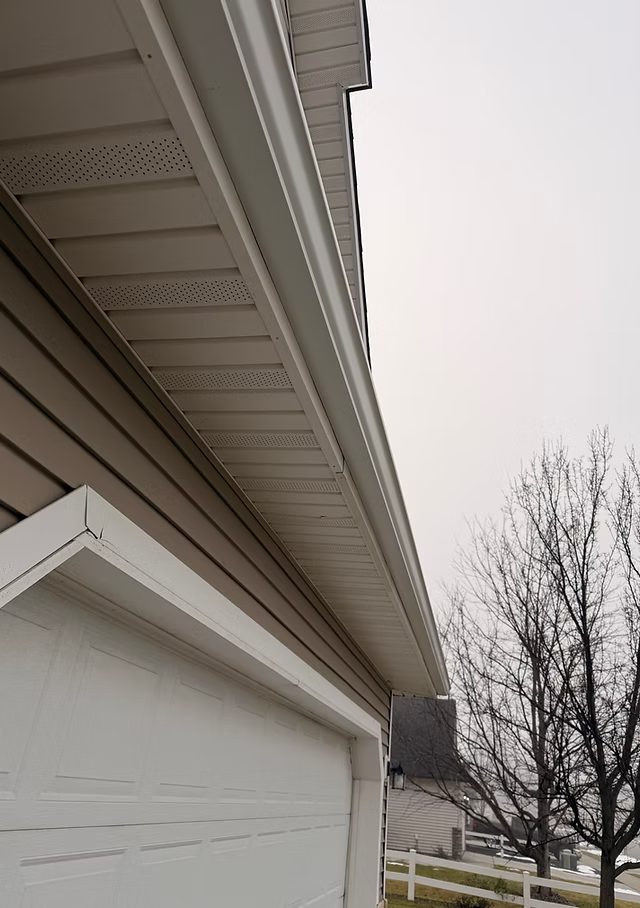
Almost every original run on these blocks was hung with spike and ferrule. A ten-inch nail through the front lip, a tube holding the spacing, driven into fascia. It worked fine in 1924. It works badly now, because the wood has been through a century of St. Louis freeze-thaw and every cycle backs the spike out a fraction.
You can spot it from the sidewalk. Look for a nail head standing proud of the front face, or a gutter line that dips in the middle of a long run. Once the back of the trough tips away from the board, water runs behind the gutter and down the fascia instead of into the downspout, and the wood starts going.
New work goes up on hidden hangers screwed into the fascia every two feet, tighter under trees where snow and wet leaves add load. They pull the back of the trough against the board instead of pushing the front away from it. It's a small change that decides whether the run is still straight in fifteen years.
Living under pin oaks near the park
The blocks closest to Forest Park and along Tamm carry heavy canopy, and pin oaks are the worst tree we deal with for gutter work. They drop tassels in May, acorns in September, and then hold brown leaves into January and let them go a handful at a time all winter. There's no single week where the tree is done.
That's the case for micro-mesh, and we'll make it where it applies. Stainless mesh over an aluminum frame keeps out everything down to the tassel and lets the run keep working through a December drop that nobody wants to climb a ladder for. It isn't maintenance-free. Mesh needs a brush-off every couple of years, more under oak.
What we won't do is put a guard over a 4-inch run and call the problem solved. Covering an undersized trough gives you a clean undersized trough. Size first, cover second, in that order. Our page on whether gutter guards are worth it goes through the honest math.
Porch roofs, dormers and the small planes nobody quotes
A bungalow front porch usually has its own short run of gutter, often the oldest metal on the house because it's the least visible from the street. It's also the one that dumps directly onto the walk where people put their feet in January. We price porch gutter as part of the job rather than leaving it off to make the number look better.
Shed dormers are the other one. A dormer sheds into the main run at a point, and that point is where debris packs. On a cleaning, that's the spot we check first. On a replacement, it's where we'll often add an outlet.
Detached garages off the alley are worth a sentence too. Most of them have no gutter at all, and most of them don't need one. Where the garage sits three feet off the house and drains toward the back door, one short run and a downspout is cheap and it keeps the walkway from icing over.
Common Dogtown jobs
Step up from 4-inch
5-inch K-style rolled on site with 3x4 downspouts sized to the roof.
Learn moreRehang and re-pitch
Spike-and-ferrule runs pulled and reset on hidden hangers.
Learn moreMicro-mesh under oaks
Stainless mesh where the canopy actually warrants covering the run.
Learn moreCleaning with the porch included
Troughs cleared by hand, outlets flushed, porch and dormer runs checked.
Learn moreMiters that drip
Old sectional joints and corners resealed or rebuilt.
Learn moreColor matching
Baked-enamel colors held against the trim before anything is ordered.
Learn more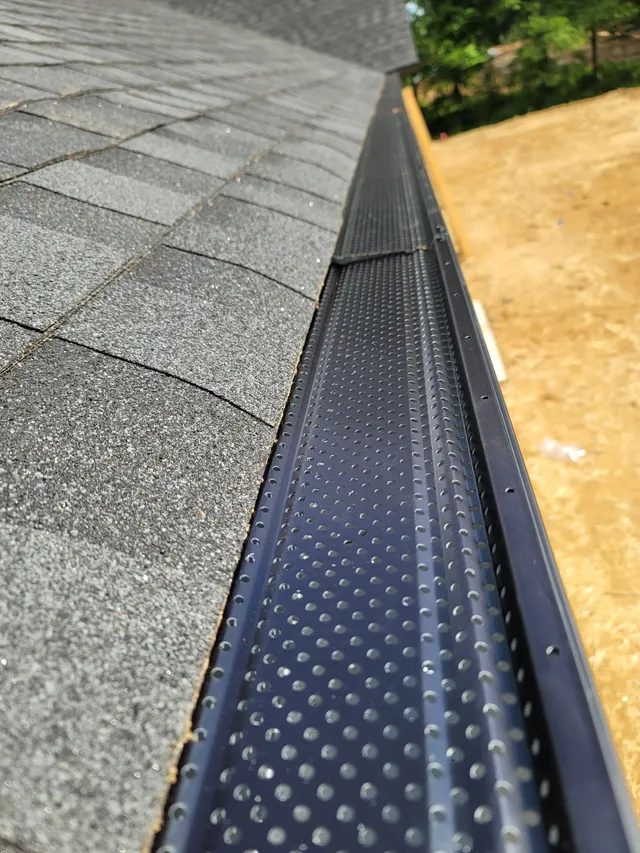
What we'd rather you spend the money on
If the budget covers one thing this year, put it into drainage away from the house before you put it into a cover over the gutter. Roof water pooling against a bungalow foundation in St. Louis clay does more damage in five years than a season of clogged troughs.
Skip the heat cable unless there's a documented ice problem on a specific run. Most Dogtown ice dams trace back to attic heat loss, not to the gutter, and cable draws power all winter to treat a symptom.
Don't replace a run that measures 5-inch, hangs straight and only leaks at one corner. That's a miter rebuild, not a replacement, and we'll write it that way. Details on leaking seams if you want to see what's involved.
And if the fascia behind the gutter is soft, that comes first regardless of what else is on the list.
Dogtown gutter questions
How do I know if my gutter is 4-inch or 5-inch?
Measure across the open top from the front lip to the back edge. Four inches means original or a like-for-like replacement. Five is standard now. A 2x3 downspout is another tell, since 4-inch runs almost always came with the small outlet.
Will bigger gutter look wrong on a 1920s bungalow?
It reads as normal from the street. A 5-inch K-style profile is only marginally taller on the fascia and the color match matters far more to how it looks than the size does. On houses with a fancy cornice we'll talk through half-round instead.
Are the pin oaks by the park bad enough to need guards?
On the blocks with real canopy, usually yes, once the run is the right size. Oaks drop something roughly nine months a year here, so the mesh earns its keep. On a house with no tree over the roof, we'd rather you clean twice a year and keep the money.
Can you gutter the garage at the same time?
Yes, and we'll price it separately so you can decide. It's a short run and the crew is already on the block, so it's rarely worth a second trip charge later.
Do you pull permits for gutter work in the city?
Straight gutter replacement generally doesn't require one. If the job grows into fascia, soffit or structural work, we handle whatever the city asks for and it goes in the written estimate before anybody starts.
Neighborhoods we cover nearby
University City · The Hill · Tower Grove · Clayton · Webster Groves · Overland
Free estimate in Dogtown
Tell us what the gutter is doing and when. We'll measure the roof above it.
A gutter company in St. Louis that grew up on bungalows
Family-run since 1947, third generation, and the phone gets answered on a Sunday.