
Why the front elevation is always the one that overflows
Look at the roof of a Tower Grove two-story from the alley and the shape explains most of our service calls. The main house has a long shallow plane that dumps everything toward the street, the rear addition has its own low-slope roof feeding into the same corner, and there's often a dormer above the front bedroom sending a third stream into the mix. All that water hits about thirty feet of trough with one outlet at the end.
Four-inch gutter carries roughly half the volume a 5-inch run does once you also step the downspout up. On a house with that much roof pointed at one edge, the trough fills, the water rides the front lip and comes down the face of the brick. Owners usually think the gutter is clogged. Sometimes it is. Often it's just undersized for the roof above it, and we can prove that with a tape measure before anybody sells anybody anything.
The second thing we look at is what's holding the run up. Original installs here were spike and ferrule driven into a fascia that's now a hundred years old and has been painted twenty times. Spikes back out a little every freeze-thaw cycle, and St. Louis gives us dozens of those between December and March. Once the spike head stands proud of the front lip, the back of the gutter tips away from the board and water starts running behind it.
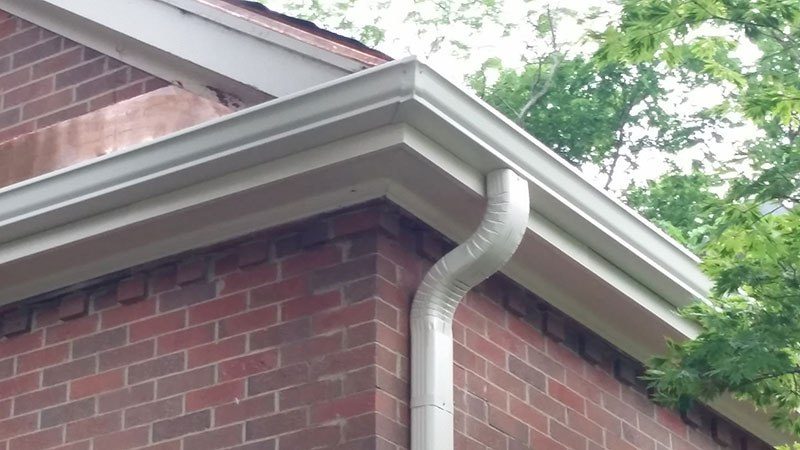
Alley access decides how the job runs
Tower Grove blocks were laid out with service alleys, and that's a gift on a gutter job. We can park the brake in the alley, roll a full-length run of gutter on site and carry it in over the fence line without shutting down a residential street. Where the alley is blocked by a garage addition or a dumpster pad, we work off the front and the day takes longer.
Side yards are the harder part. Gangways between these houses run four to eight feet wide, and a 28-foot extension ladder needs a footprint that fits and ground that isn't mud. When the neighbor's fence sits in that gap we set from their side with permission, which is a conversation we'd rather have during the estimate than on install morning.
Where the water goes after it leaves the downspout
This is the part that costs Tower Grove owners real money, and it has nothing to do with the gutter itself. A downspout that empties into the gangway is pouring roof water onto a narrow band of clay that two foundations are sitting on. St. Louis clay swells when it's wet and shrinks when it dries. That cycle, repeated at the same spot every storm for years, is how a straight basement wall in a hundred-year-old house starts to bow.
Our fix is boring and it works: get the discharge past the corner of the building. Sometimes that's a rigid extension along the base of the wall. On a tight lot it's solid PVC buried below the frost line running to a pop-up emitter in the front yard, with a cleanout so it can be rodded if a root finds it. We won't bury flex pipe. It kinks, it silts up, and in five years you're digging it back out.
If there's already water in your basement, read how gutters put water in a basement before you spend anything on the inside.
Fascia, cornice and the trim behind the gutter
Half the gutter calls we take in south city turn into a wood conversation. The gutter on these houses hangs on a wood fascia that often sits under a decorative cornice, and when the back of the trough has been leaking for two winters the board behind it goes soft. A hanger screwed into soft wood holds until the first heavy snow slides off.
We probe the board before we quote. If it's punky, it gets replaced and wrapped, and only then does new gutter go on it. Doing that in the other order is how a homeowner pays twice. On houses with an original ornamental cornice we work around the detail rather than covering it, because the trim is part of what makes the block look the way it does.
What we do on Tower Grove houses
Repair the run you have
Rehang on hidden hangers, reseal miters, correct pitch, clear a plugged outlet.
Learn moreStep up from 4-inch
New 5-inch or 6-inch aluminum rolled on site, sized to the roof above it.
Learn moreGet water out of the gangway
Extensions, buried solid PVC and emitters that discharge past the foundation.
Learn moreFascia repair first
Soft board replaced and wrapped before anything new gets hung on it.
Learn moreCleaning, including the rear roof
Hand-cleared troughs and flushed downspouts, dormers and additions included.
Learn moreGuards where the trees warrant it
Stainless micro-mesh for the blocks under heavy park canopy.
Learn more
Things we'll talk you out of
Guards on a run that's already failing. If the pitch is wrong and water stands in the trough, covering it doesn't fix the standing water, it just hides it from you. Fix the hang first, then decide about guards.
Copper on a house that isn't asking for it. Copper is beautiful and it belongs on some St. Louis homes. On a plain brick two-story with a painted cornice, painted aluminum in the right color looks correct and costs a fraction. We install both and we'll tell you which one this house wants.
A cleaning when the real problem is a downspout crushed flat behind the porch column. We find that one two or three times a season. Clearing the trough above it changes nothing.
Tower Grove sits between blocks we work constantly. Neighbors in University City and homeowners over in Affton deal with different housing stock and different failures, and the estimate reflects that.
Tower Grove gutter questions
Can you get a truck down our alley?
Usually yes, and that's how we prefer to work Tower Grove. Alleys give us a place to set the brake and roll gutter without blocking the street. Where the alley is too tight or a garage crowds it, we roll on the street side and carry the run back.
Our gutter is 4-inch. Does it have to be replaced?
Not always. If the metal is solid and the only complaint is overflow at one corner, a bigger downspout or a second outlet can fix it. If the trough is thin along the bottom or the front elevation drains a lot of roof through one 2x3, going to 5-inch with a 3x4 downspout is the honest answer.
What does the water do to the gangway between houses?
It saturates the strip of clay soil the two foundations share, which is the worst place in the whole lot to dump roof water. We extend or bury the discharge so it comes out past the corner of the house instead of six inches from the wall.
Do you work on the third-floor dormers?
Yes. Most Tower Grove two-stories have a dormer or a rear addition roof that feeds the main run, and those small planes are where clogs start. We clear them on the same trip rather than sending a second crew.
How long does a full gutter replacement take on a house like ours?
A typical brick two-story here is a one-day job, sometimes a day and a half if fascia has to be replaced first. Rain moves it, and we'd rather push a day than hang gutter on wet wood.
Blocks we work most
South City · The Hill · St. Louis · Webster Groves · University City · Affton · Crestwood · Oakville
Free estimate in Tower Grove
Tell us which elevation is misbehaving. We'll come measure the roof, not guess.
More on south city gutters
A St. Louis gutter company that knows south city brick
Third generation, family-run since 1947, and somebody picks up at two in the morning.