
Why the spike is the first thing we look at
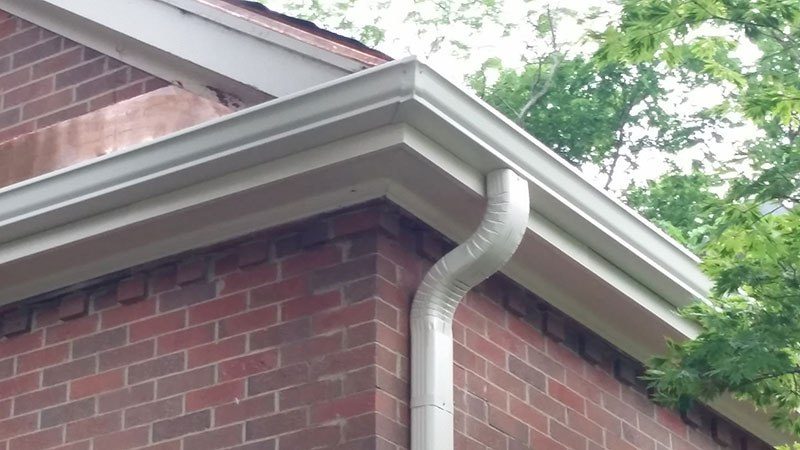
Walk a block anywhere south of Chouteau and you can read the gutters from the sidewalk. Look along the front lip for nail heads standing out past the face of the metal. Every one of those is a spike that has walked its way out of the fascia, and there's a good chance the ferrule behind it is loose in the hole too.
The mechanism is simple. Wood swells when it takes on water and shrinks when it dries, and St. Louis runs that cycle dozens of times between Thanksgiving and March. A smooth nail in that wood loses grip a hair at a time. Add the weight of a trough full of wet leaves in November and a load of sliding snow in January, and the top of the gutter starts pulling away from the board.
Once there's a gap at the back, everything downstream gets worse. Water sheets behind the trough onto the fascia, soaks the end grain, and finds the soffit. Paint blisters below the gutter line first, which is usually what a homeowner notices, months after the actual failure started.
What rehanging actually involves
We pull the old spikes, check the fascia along the full run, and set hidden hangers on roughly two-foot centers, screwed rather than nailed. Where the board is sound, that's the whole repair and the run is straighter afterward than it was new.
Pitch gets reset at the same time. The rule of thumb is about a quarter inch of fall for every ten feet toward the outlet. Too flat and water stands in the trough and breeds mosquitoes by July. Too steep and the run looks crooked against a level brick course, which on a south city house is very visible from the street.
Corners are the other repair point. Old strip miters open up as the metal moves, and a sealed joint that's been through twenty summers gets brittle and cracks. We rebuild the miter and seal it properly rather than smearing caulk over the outside of a joint that's already failed.
When the metal is past saving
A rehang doesn't help if the trough itself is finished. The tells are thin spots along the bottom where a screwdriver handle flexes the metal, pinholes at the low end of a run, and a bottom seam that's gone rusty on steel gutter. We'll also call it done when the run has been patched so many times that the inside is a ridge of sealant that traps debris.
Size is the other reason to replace. A lot of the older brick housing stock still runs 4-inch trough on roofs that need 5-inch, and the newer aluminum somebody hung on a rental in the 1990s is often thin builder-grade stock. Heavier .027 aluminum holds a shape under a ladder and under snow load. We roll runs on site so a whole elevation goes up as one piece.
Cost tracks linear feet, the number of stories, downspout count, and whether wood has to be replaced first. We quote in writing, and the workmanship warranty on our installations is a lifetime warranty. Our page on what gutters cost in St. Louis walks through the drivers without pretending there's one price.
Getting the water past the brick
South city foundations are brick or limestone sitting in clay, and clay is the reason a drainage detail matters more here than the gutter does. Wet clay swells against a wall and dry clay pulls away from it. Do that at the same spot every storm for a decade and a straight wall starts to bow.
The cheap version of the fix is a rigid extension carrying discharge four to six feet out. The better version on a tight lot is solid PVC buried below frost to a pop-up emitter, with a cleanout where the line turns. Either beats a splash block sitting in a flower bed.
If the basement is already taking water, start with how gutters put water in a basement before spending anything on interior work. Fixing the roof water first sometimes makes the rest unnecessary.
South city gutter work we do most
Rehang on hidden hangers
Spikes pulled, pitch corrected, miters rebuilt on runs that are still good metal.
Learn moreFull replacement
Heavier aluminum rolled on site and sized to the roof planes above it.
Learn moreFascia repair
Soft board cut out, replaced and wrapped before new gutter goes up.
Learn moreDrainage away from brick
Extensions, buried solid line and emitters that discharge past the foundation.
Learn moreCleaning and flushing
Hand-cleared troughs, flushed downspouts, rear additions and dormers included.
Learn moreGuards where they pay off
Micro-mesh on blocks with real canopy, once the run underneath is right.
Learn more
Where we'll tell you to wait
If the only complaint is one drip at one corner on an otherwise straight run, that's a repair. We'd rather rebuild the miter this spring and look at the rest of the house in a few years than write a replacement you don't need.
If a storm just came through and someone knocked on your door offering to handle the whole thing through your insurance, slow down. Real storm damage to gutter is worth documenting properly, and our page on gutters and insurance claims explains what an adjuster actually looks for.
If your run measures 5-inch, hangs level and only overflows during the heaviest ten minutes of a summer cell, an added outlet is often the whole answer.
And if the fascia is soft, no amount of new metal fixes it. Wood first, then gutter, every time.
South City gutter questions
Can old gutter be rehung, or does it all have to come down?
If the metal is sound, rehanging is real work and it lasts. We pull the spikes, set hidden hangers on two-foot centers, reset the pitch and rebuild the corners. Replacement is for thin, pinholed or badly undersized runs.
What is the pitch supposed to be?
Roughly a quarter inch of fall per ten feet toward the outlet. Enough that the trough drains dry between rains, not so much that the line looks tilted against a brick course.
Why does the paint keep peeling on the boards under my gutter?
Water is getting behind the trough and running down the fascia. That's a hanging problem or an open back seam, not a paint problem. Repainting before the gutter is corrected buys you one summer.
Do you charge for the estimate on a repair that small?
No. Estimates are free, including the ones where we come out, look at it and tell you the run has another decade in it.
Who backs the work if something goes wrong in five years?
We do. John Beal Roofing has been family-run since 1947 and is on its third generation, and our installations carry a lifetime workmanship warranty. The same phone number answers then as answers now.
South city neighborhoods we work
Tower Grove · The Hill · Dogtown · Affton · Oakville · Crestwood
Free estimate in south city
Give us the block and what the gutter is doing. We'll come look at the wood too.
Dig into the details
The St. Louis gutter company south city calls
Third generation, family-run since 1947, BBB A+, and somebody answers at 3 a.m.