
What's standing on these blocks
Walk the streets off Macklind or Hampton and you'll see the same bones over and over: one-and-a-half story brick bungalows, hip or front-gable roofs, a front porch with its own little roof, and a garage out back on the alley. Most went up in the 1920s and 1930s.
Very few still have their original gutters. Many were redone once, decades ago, with sectional aluminum that now leaks at every joint. Some still carry 4-inch troughs sized for a time with a lot less tree cover.
The brick is the good news. Keep water off it and it ages well.
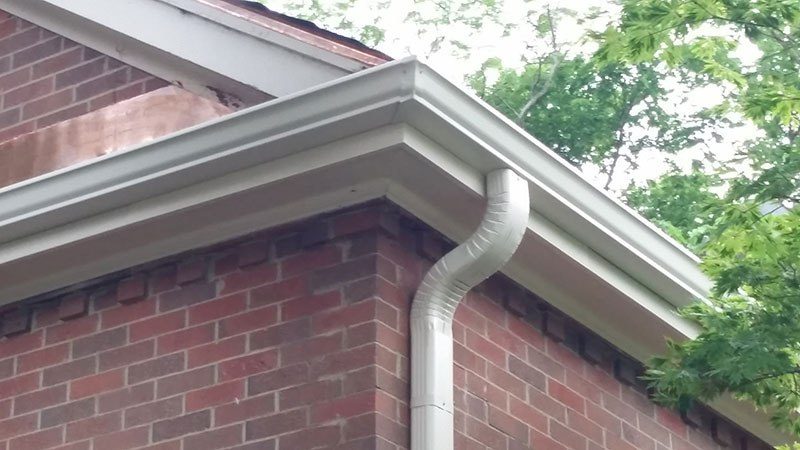
Porch roofs with their own gutter
Ten or twelve feet of gutter across the porch is easy to ignore. Short as it is, it often has the worst drainage on the house. The downspout drops right next to the front steps, so the water lands where people walk.
In January that's a sheet of ice on the top step. We'll usually move that downspout to the far corner of the porch, or run an extension alongside the steps, so the water ends up in the yard instead of on concrete.
Gangways and the neighbor's foundation
Side yards here are tight. Many houses sit a few feet from the next one, with a concrete gangway between. A downspout emptying into that gap has nowhere to go but toward a foundation, yours or your neighbor's.
St. Louis clay takes water in slowly, so that runoff pools against the brick and finds the basement. Longer extensions angled toward the back yard, or a downspout moved to the rear corner, are the usual fixes. Ladder work in a three-foot gangway is awkward, which is one reason a two-person crew matters on these houses.
The garage on the alley
Detached garages are where we find the most neglect. Plenty have no gutter at all, or a rusted steel one older than the homeowner. Roof water drops along the alley side, undermines the slab edge and rots the bottom of the doors and trim.
A garage gutter is a short run on its own and one of the cheaper jobs we do. Before we hang one, we check the fascia, because on an old garage it's often soft. New gutter on rotten wood just schedules the next repair.
Clay tile drains in the yard
Some of these houses still have downspouts plugged into old clay tile pipe running underground. Decades of roots crack those lines, and when one collapses the water backs up at the downspout and spills at the foundation.
We'll often recommend disconnecting a failed tile line and running the downspout to a surface outlet. It's simpler, and you can see when it's working. Our page on downspouts that won't drain covers how to tell if the buried pipe is the problem.
Parkway trees and what they drop
The street trees that make these blocks pleasant also fill the gutters. Pin oaks drop tassels in May and hang onto brown leaves into winter. Silver maples send seeds spinning onto every roof in spring. A bungalow's low roof catches all of it.
Two cleanings a year handles most houses here. On the ones right under a big oak, a fine mesh guard can cut that down to an occasional look.
Around Southampton
Princeton Heights bungalows
Similar brick houses and detached garages close by.
Princeton Heights gutters →Across Hampton in St. Louis Hills
Hip roofs and long corner runs on the west side of Hampton.
St. Louis Hills gutters →Bevo Mill hip roofs
Gutter sizing on the hip-roofed brick homes nearby.
Bevo Mill gutters →The wider south side
Our broader page for the city's south neighborhoods.
South city gutters →
What a bungalow here rarely needs
Six-inch gutters across the whole house. A bungalow roof is small, and a properly sized 5-inch gutter with enough downspouts usually handles it. We'd add a downspout before we'd upsize everything.
A full replacement because the porch run failed. If the main gutter is sound, we'll replace the porch section and leave the rest.
Copper half-round to match the era, unless you want it. It looks right on some of these houses and it's a real upgrade, but it costs far more than aluminum, and nobody needs it to keep a basement dry.
If the old sectional gutter has to go, our seamless gutter installation page explains what replaces it.
Southampton gutter questions
Why does my porch downspout freeze over the front steps?
Because it empties right beside them. Water runs across the concrete and freezes overnight. Moving the downspout to the other corner of the porch or extending it past the steps keeps the walk dry.
Should my detached garage have gutters?
In most cases, yes. Without one, roof water drops along the walls, erodes soil at the slab and rots wood trim and doors. A single short run with one downspout is usually all a garage needs.
What can I do about a downspout draining into the gangway?
Send the water toward the back yard instead of toward either foundation. A longer extension, a rerouted downspout or a move to the rear corner usually does it, depending on how the yard slopes.
Are 4-inch gutters on an old bungalow enough?
Sometimes, on a very small roof with light tree cover. Most of the time we'd go to 5-inch, which holds noticeably more water. We'll look at the roof and the trees before recommending either.
Do you work on old clay tile drain lines?
We'll find out whether a tile line is still carrying water. If it's collapsed or full of roots, we usually disconnect it and run the downspout to an above-ground outlet rather than dig up and replace the old pipe.
Get a free Southampton gutter estimate
Let us know whether the porch, the garage or the gangway gives you the most trouble, plus your cross street.
Your Southampton gutter contractor, out of Maryland Heights
A family business since 1947 and third generation today, with a BBB A+ rating and a place on the Roofing Contractor Magazine Top 100 list. Lifetime workmanship warranty, free estimates, and a person on the phone at any hour.