
Which metal is hanging on your house
Pull a magnet out of the kitchen drawer and set it on the gutter. If it sticks, you've got steel, most likely galvanized, and those orange streaks are rust. If it drops off, the gutter is aluminum or copper, and whatever you're seeing is a different kind of corrosion with different causes.
Most St. Louis houses that were built or re-guttered in the last few decades have aluminum. Steel still turns up on older brick homes in south city and on some commercial buildings, sometimes painted so many times nobody remembers what's under there. Copper shows up on restorations and the odd bay window.
Sort that out before anybody prices a fix.
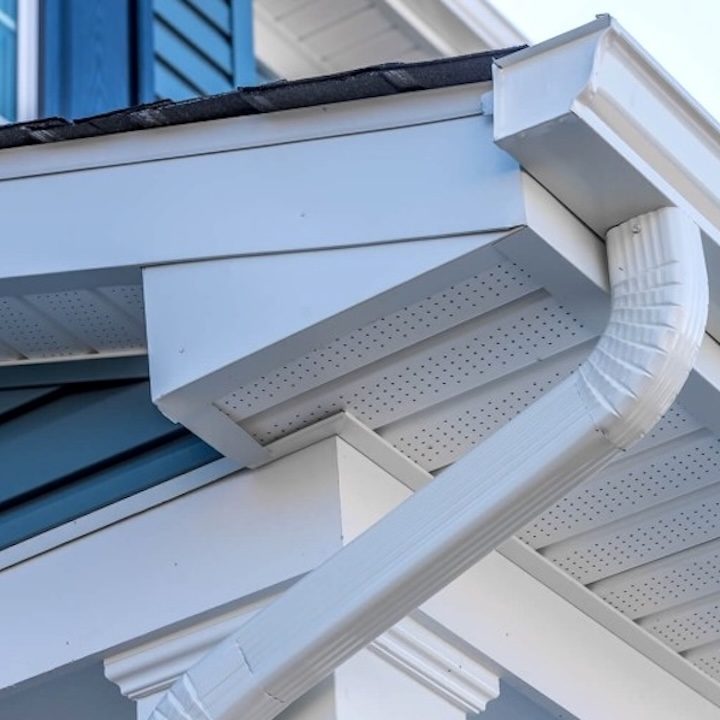
Where steel gives out first
Galvanized steel is protected by a thin layer of zinc. The zinc wears away slowly on purpose, and as long as some is left the steel underneath stays clean. It goes fastest where water and debris sit longest, which is the flat bottom of the trough right in front of the downspout outlet. Oak leaves packed in there can stay wet for weeks. The tannins leaching out of them don't help.
Seams, end caps and any edge a crew cut without treating come next. A gutter that's been walked on, leaned on or hit with a ladder has scratches through the coating. Those start bleeding orange within a few years.
The white crust on aluminum
Aluminum grows its own oxide skin, a dull gray or white chalkiness that's mostly cosmetic. The baked enamel on a modern gutter keeps most of that off the outside. Inside the trough, where the finish is thinner and leaves sit, you'll sometimes find shallow pits along the bottom.
On a decent gauge those take a very long time to go all the way through. The thin .019 builder-grade gutter hung on a lot of newer St. Charles builds is less forgiving. It dents, holds water in the dents, and pits there first.
Two metals touching
This is the one that catches people off guard. When copper and aluminum touch, or water that ran over copper drips onto aluminum, the aluminum corrodes fast. It's called galvanic corrosion. We find it where a copper valley, a copper bay roof or a copper chimney cap drains into an aluminum gutter, and the aluminum below the copper gets eaten while the rest of the run looks fine.
Steel screws in aluminum, or galvanized hangers in a copper gutter, cause smaller versions of the same thing. The cure is fasteners that match the gutter metal, or stainless, and keeping copper runoff off aluminum entirely.
Stains that aren't the gutter's fault
Orange streaks down the fascia or brick don't always mean the trough is rusting through. Old steel spikes and ferrules rust long before the gutter does, and they leave the same stain. So do rusty nails along a drip edge.
We look at what's actually bleeding before writing anything up. Sometimes the right job is pulling the spikes and rehanging a gutter that still has years left in it on hidden hangers.
Patch, coat or replace
Surface rust on sound metal can be wire-brushed, primed with a rust-inhibiting primer and painted. That's a fair repair on a steel gutter that's otherwise straight and pitched right. A single pinhole can take gutter sealant and a small metal patch on the inside.
Past that point we get honest about the math. A patch on a thinning trough starts leaking around its edges after a couple of freeze-thaw winters, because the metal around it keeps wasting away. If the bottom has pinholes in three or four spots, or a screwdriver pushes through, that run is done. Most owners switch to aluminum when they replace, since it won't rust and costs less than heavy steel. Our steel gutters page covers the houses where steel is still the right call.
Rust usually travels with standing water
A gutter rusts out because it held water for years, and standing water means a slope or drainage problem. Replace the metal without fixing the pitch and the new gutter holds water too. Aluminum shrugs it off better than steel did. The puddle still freezes, still adds weight and still raises mosquitoes in July.
So the new run gets a steady fall to the outlet and we check the downspout under it. If the board behind it went soft from years of dripping, it's replaced before anything gets hung, and rotted fascia board explains how we check. For a whole-house swap, see gutter replacement.
What a rust inspection covers
We tap the bottom of the trough every few feet with a screwdriver handle and listen. Solid metal rings. Thin metal thuds, and sometimes it dents. Every seam and end cap gets checked from the inside, along with the hangers and the wood behind them, and a garden hose shows where the water really goes.
Then you get a straight, written answer about which runs can be saved and which can't. The estimate is free. Hold it up against anybody else's.
Related reading on worn-out gutters
Signs a run is finished
The tells that a gutter has stopped being worth fixing.
When to replace gutters →Drips where two pieces join
Why joints let go first and what a reseal can and can't do.
Leaking gutter seams →Copper and its green coat
Patina is a finish, not a failure. Here's how to tell them apart.
Copper gutters →
Rust jobs we turn down
Painting over rust-through. A coat of paint on a gutter with holes in it looks good from the street for about one summer.
Roll-on liner coatings sold as a cure for a whole rotted system. On a house, that money usually does more as new aluminum.
Copper downspouts on an aluminum gutter, or the reverse. It looks sharp for a while, then the aluminum starts to go.
Replacing every gutter on the house when one corroded stretch under a copper valley is the only problem. We'll fix that stretch and send the copper water somewhere else.
Rust and corrosion questions
Do aluminum gutters rust?
No. Rust is iron oxide, and aluminum has no iron in it. Aluminum can still corrode, which shows up as a chalky white film or small pits, and it corrodes quickly where it touches copper.
Why is my gutter rusting only near the downspout?
That's where debris and water sit the longest, so the zinc coating on steel wears through there first. A slow outlet or a low spot in front of it speeds things up.
Can I seal a rusty gutter myself?
For a small spot on sound metal, yes. Wire-brush it, prime it with a rust-inhibiting primer and use gutter sealant on the inside. If the metal flexes or flakes when you press on it, sealing won't last.
Is the green on copper gutters a problem?
Usually not. That green-blue patina is a stable layer protecting the copper under it. Real trouble on copper looks like split solder joints or holes worn through by grit, not a color change.
Are the rust stains on my brick coming from the gutter?
Sometimes. Just as often it's old steel spikes, ferrules or nails rusting and streaking down the wall. Find what's bleeding first, because swapping fasteners costs far less than a new gutter.
Show us the rust
Tell us where the spots are and whether the gutter is steel, aluminum or a mystery.
Swap rusted runs with a St. Louis gutter company
John Beal Roofing has been a family business since 1947 and is in its third generation of Beals. A live person answers the phone around the clock. We're BBB A+, Owens Corning Platinum Preferred and a Roofing Contractor Magazine Top 100 company, new gutters carry our lifetime workmanship warranty, and the estimate costs nothing.