
The usual tenants on a St. Louis roofline
House sparrows and starlings are the most common. They like the corner where two gutter runs meet and the top of a downspout, where the outlet gives them a little cave. Robins build on the gutter lip under an overhang. Paper wasps hang their nests under the front edge or just inside a downspout.
Squirrels don't usually nest in gutters. They use them as a highway between the trees and the roof, and they chew. Mosquitoes breed in any stretch that holds standing water through a warm week.
Each one calls for a different response, so it helps to know who's up there before anything gets pulled out.
A nest sitting on the outlet
Birds build where it's tight and sheltered, and in a gutter that usually means right over the downspout hole. The result is a plug of grass, twigs and feathers exactly where water needs to leave. Spring nesting lines up with oak tassel season in May, so the nest catches tassels and the clog grows fast.
The first sign is often water spilling over one corner in a storm the gutter used to handle fine.
Timing matters with active nests
Most native songbirds, robins included, are protected under federal law, and an active nest with eggs or chicks shouldn't be disturbed. House sparrows and starlings aren't native and don't carry that protection. We still prefer to wait out a nest with young in it when we can, since a brood is gone in a few weeks.
Once the nest is empty, it comes out, the gutter and downspout get flushed, and then we can talk about keeping birds from coming back.
Wasps under the gutter lip
Paper wasp nests tucked under the front edge of a gutter are easy to miss until you put a ladder against it. That's a bad way to find one. If you see wasps going in and out under the gutter or at the downspout top, have a pest control company treat it first. Our crews won't work a section with an active nest.
Late fall, after a couple of hard freezes, the nests are abandoned and can be scraped off during a cleaning.
Squirrels running the gutter
A squirrel's route is usually a branch over the roof, down onto the gutter, along to a corner and up. Where the gutter meets the roof edge, they sometimes chew through the fascia or a soffit vent and get into the attic.
Guards don't stop that. What helps is keeping limbs well back from the roofline and replacing chewed wood with solid material. If the soffit or fascia already has a hole, our soffit and fascia crews can rebuild it so there's nothing soft left to chew. Getting the animal out of the attic is a job for wildlife removal, not us.
Standing water and mosquitoes
A gutter that holds an inch of water through a humid St. Louis July is a mosquito nursery. It doesn't take much: a low spot, a wad of silver maple seeds at the outlet, or a downspout plugged at the elbow. Clearing it and restoring the slope dries it out. If water still sits after a rain, the problem is pitch or drainage, and downspout not draining is the place to start.
Where guards earn their keep
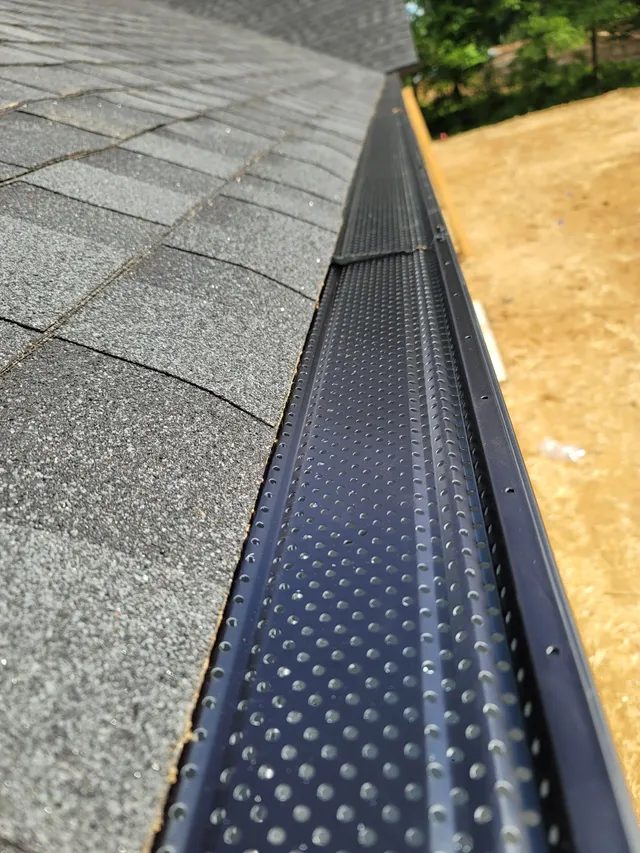
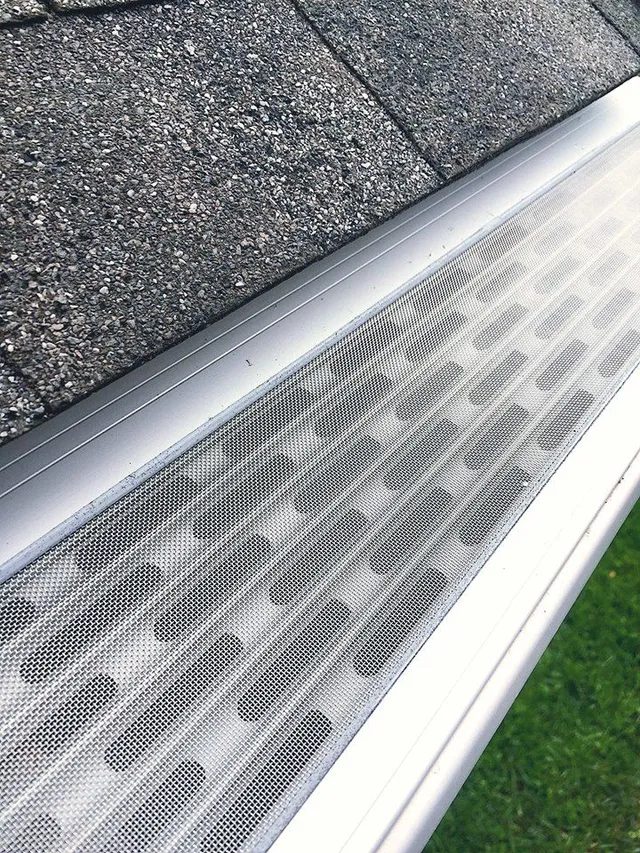
A fine micro-mesh guard closes the top of the trough, so there's no sheltered pocket for a nest and no pile of leaves to build with. It's the one product we'd recommend for a house where birds keep coming back. Coarse plastic screens and wide-slot covers are another story. Birds perch on them, build on top of them, and sometimes squeeze underneath.
Our guard types compared page lays out the differences, and micro-mesh gutter guards covers the system our St. Louis gutter company installs.
More on keeping the trough clear
Things we leave to someone else
Poison, glue boards and bird spikes on the gutter edge. Spikes catch leaves and become their own clog, and the rest isn't our trade.
Pulling an active songbird nest so a job can finish on schedule. The job can wait a couple of weeks.
Trapping squirrels or raccoons. A licensed wildlife removal company handles that, and we'll repair the entry points afterward.
Nesting and pest questions
Can I remove a bird nest from my gutter?
If it's empty, yes. If it has eggs or chicks and belongs to a native bird like a robin, leave it until the young have flown. That usually takes a few weeks. Then clean the gutter and flush the downspout.
Why do birds keep nesting in the same gutter corner?
Corners and downspout tops are sheltered, and old nesting material gives them a head start. Clearing it completely and covering the trough with a fine mesh guard removes the reason to return.
Do gutter guards keep squirrels out?
Not reliably. Squirrels walk over guards and chew where they want. Guards keep birds and debris out of the trough, while squirrel trouble is solved with tree trimming and solid wood at the roofline.
Can gutters cause a mosquito problem?
Yes, if they hold standing water. A clog or a low spot can keep a puddle in the trough for days in warm weather, which is plenty of time for mosquitoes to breed. Restoring the slope and clearing the outlet dries it out.
Will you clean a gutter that has a wasp nest in it?
Not until the nest is treated or abandoned. Have a pest control company handle active wasps first. After that, we can clean the gutter and scrape off the empty nest.
Tell us what's moved in
Birds, wasps, squirrels or standing water, and where on the house you're seeing it.
Nest-proof gutters from a St. Louis gutter company
The Beal family has run this business since 1947, and the third generation runs it now. BBB A+, Roofing Contractor Magazine Top 100 and Owens Corning Platinum Preferred. Every installation carries our lifetime workmanship warranty. Call at any hour for a free estimate.