
What a hanger actually carries
An empty five-inch aluminum gutter weighs next to nothing. Full of water, a ten-foot stretch can hold something like a hundred pounds, and packed wet leaves or a January ice load add more on top.
Every hanger along that run takes a share of the weight. Space them too far apart and the gutter bellies between them. Use a fastener that loosens and the whole run slowly tips forward off the board.
Most of the gutter calls we get start right here.
Spikes and ferrules
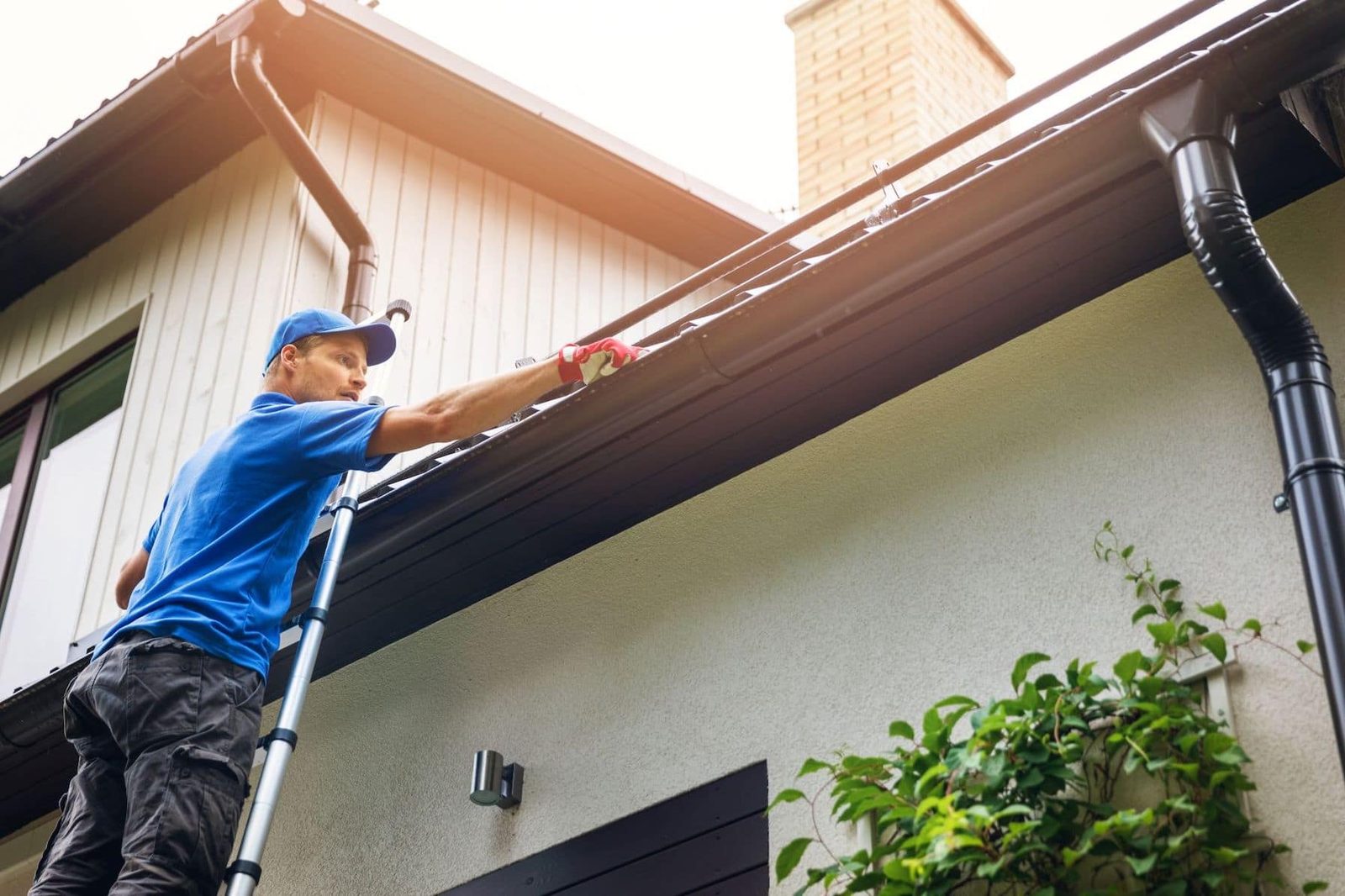
A spike is a long aluminum or galvanized nail that goes through the front of the gutter, through a short tube called a ferrule that keeps the gutter from crushing, and into the fascia. It's quick to install, and you'll find it on a lot of 1950s ranches in north county and on many older repairs.
The weak point is the nail itself. Wood swells and shrinks every season, and freeze-thaw works the spike out a fraction at a time. First you see spike heads standing proud of the gutter face. Then the gutter dips.
Re-nailing into the same hole rarely holds. The wood around it is already chewed out.
Hidden hangers with screws
A hidden hanger is a bracket that hooks under the front lip of the gutter and fastens to the fascia with a screw through the back. You can't see it from the ground, and because it braces the front edge, the gutter keeps its shape under load.
Screws hold where nails back out. When we rehang a spiked gutter or replace one that's pulling loose, this is what goes on, and the old spike holes get sealed.
Straps for houses with no usable fascia
Some houses don't have a fascia board you can fasten into, or the board is a thin trim piece over exposed rafter tails. Straps solve that. They run up from the gutter and fasten to the roof deck under the first course of shingles.
They work, but they mean lifting shingles, and on an older roof that can crack tabs. We'd usually suggest them only during a roof replacement or when there's truly nothing else to screw into. Half-round gutters on older homes often hang from exposed brackets instead, which is its own system; see half-round gutters.
How far apart they go
There's no single magic number, but two feet on center is a sensible baseline for a residential K-style gutter. Under a roof valley, where water off two slopes hits one short stretch, we tighten that up. Same under silver maples and pin oaks.
Thirty-six inches shows up a lot on builder installs. On a heavy-leaf street with no guards, that's thin.
Guards add a little weight in a wet snow, so spacing gets a second look when they go on. More on that in micro-mesh gutter guards.
The board behind the bracket
A hanger is only as strong as the wood it's screwed into. Soft fascia, which you'll find behind gutters that overflowed for years, won't hold a screw any better than a nail. Push a screwdriver into the bottom edge of the board. If it sinks in easily, that section has to be replaced before any gutter goes back up.
We replace rotted fascia as part of the job when we find it, and you'll hear about it at the estimate, not halfway through the install. Rotted fascia board covers what that involves.
Hangers set the pitch, too
Gutters need a slight fall toward the downspout, commonly around a quarter inch per ten feet. The hangers hold that line. When one drops, water pools at the low spot, sits there and grows a little mat of grit and maple seeds.
A gutter still holding standing water two days after a rain usually has a hanger problem, not a cleaning problem.
When the hangers have already let go
Hanger fixes we won't sell you
Longer spikes driven into the old holes. It looks fixed for a season, then the ferrule tears through or the spike walks back out.
Extra brackets screwed between the old ones on a gutter that's already kinked. Once aluminum creases, more hangers won't straighten it.
A full replacement when the trouble is three loose spikes on a gutter that's otherwise straight. Swapping those for hidden hangers is a small repair, and we'll tell you so.
Gutter hanger questions
Are hidden hangers better than spikes?
For holding a gutter over the long haul, yes. A screw doesn't back out the way a spike does in swelling and shrinking wood, and the bracket braces the front lip. Spikes go in faster, which is why some builders still use them.
Can I replace a few loose spikes myself?
You can swap a few for hidden hangers from a ladder if the fascia is sound. Drive the screw into fresh wood beside the old spike hole, and check that the gutter still falls toward the downspout afterward.
Why are my gutter spikes popping out?
The fascia swells and shrinks with the seasons, and freeze-thaw slowly pulls the spikes loose. Heavy wet leaves or ice speed it up. Once a few let go, the ones beside them carry extra weight and follow.
How many hangers should a 30-foot gutter have?
At two-foot spacing that's about fifteen, plus extras near the ends and under any valley. A builder install at three-foot spacing would have closer to ten.
Do gutter straps damage the roof?
Installing them means lifting the first row of shingles to fasten into the deck, which can crack brittle older shingles. On a new roof they go in cleanly. On an old one we'd only use them if there's nothing solid at the fascia.
Gutter hanger estimate
Tell us where the gutter dips or pulls loose and roughly how long the run is.
Gutters hung to stay put by a St. Louis gutter company
The Beal family has run this business since 1947, and it's on its third generation. Call any hour and a live person picks up. Estimates are free, the work is backed by a lifetime workmanship warranty, and our credentials include a BBB A+ rating, Owens Corning Platinum Preferred status and a spot on Roofing Contractor Magazine's Top 100.