
Where it belongs
Historic districts — Old Webster, Parkview and University Heights, Old Town Kirkwood, the Clayton Tudors. On those homes a K-style bolted over original eave detail reads as wrong even to people who couldn't name why.
It also suits modern architecture that wants a clean line without the decorative K profile.
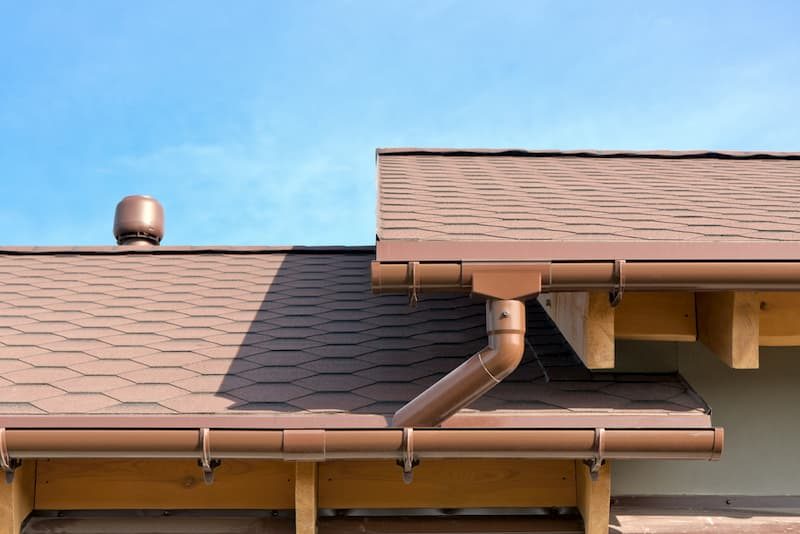
Debris behavior
A round bottom means water moving through the trough scours it. K-style has a flat floor and an inside angle where wet debris settles and stays.
That doesn't make half-round self-cleaning. It does mean it tolerates a missed cleaning better.
Capacity and cost
A 6-inch half-round holds roughly what a 5-inch K-style holds, because the round cross-section is smaller for the same nominal width. Size up accordingly — we usually spec 6-inch half-round where 5-inch K would have gone.
It costs more. The material, the brackets, and the fabrication all run higher, and copper half-round is a different tier again. On the right house it's worth it.
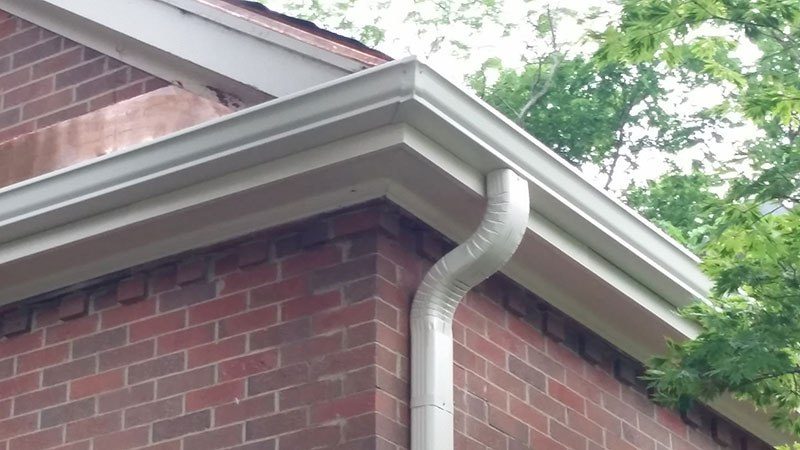
Brackets and hanging
Half-round hangs in brackets, either fascia-mounted or roof-mounted on straps. Bracket spacing and alignment is more exacting than K-style because any inconsistency shows as a wave in the line.
We hang it on a string line. A half-round run that isn't dead straight looks worse than no gutter.
Questions people ask
Is half-round more expensive?
Yes, typically noticeably more than K-style in aluminum, and more again in copper.
Does half-round hold less water?
For the same nominal size, yes. We usually go one size up to compensate.
Can I get half-round in aluminum?
Yes, and in a range of colors. Copper is the traditional choice but aluminum half-round is common and much less expensive.
Can gutter guards go on half-round?
Yes, there are micro-mesh products made for the round profile.
Free estimate
We measure, we look at the fascia, and you get a number in writing.
Talk to a real St. Louis gutter company
Third generation, family-run since 1947. Somebody picks up, day or night.