
Thousandths of an inch you can feel
Hold a scrap of .019 in one hand and .032 in the other and you'll know which is which with your eyes closed. The thin piece flexes like a pie tin. The thick one fights back.
On paper it's thirteen thousandths. In practice the heavier coil is roughly two-thirds thicker, and the gutter it forms keeps its shape when someone leans a ladder on it or a wet snow slides off the roof.
Seamless gutters are rolled on site from a coil, so the gauge is whatever coil is on the truck that day.
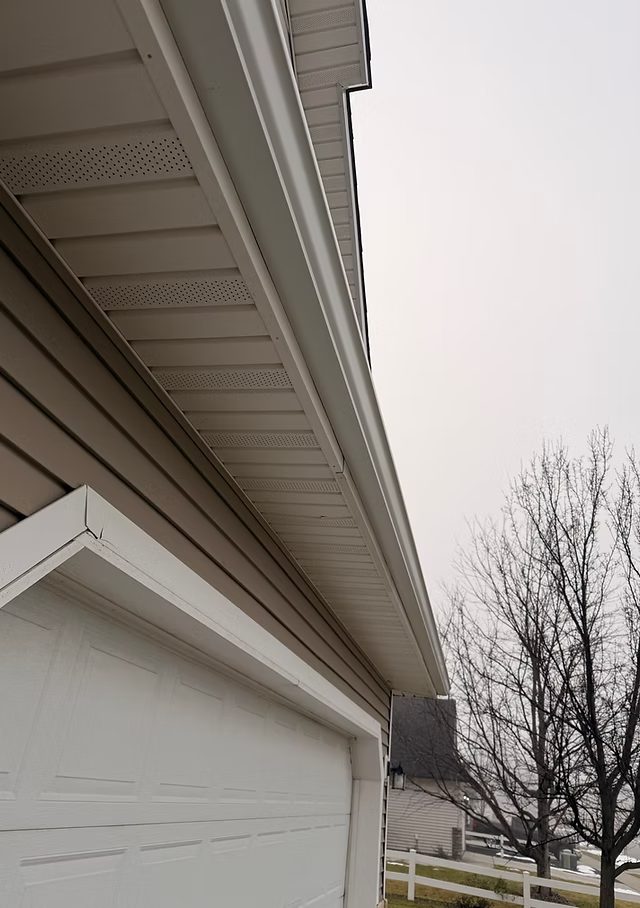
.019, the builder-grade coil
This is the thin stuff. You'll find it on plenty of newer St. Charles County subdivisions, where gutters went up on hundreds of houses at once and every cent per foot counted. It carries water. It just doesn't take much abuse.
The usual failures: a crease where a ladder rested, a belly between hangers after the first heavy leaf season, an end cap that lets go. Thin metal also moves more as it heats and cools on a summer day, and that movement works at the corners.
.027 for everyday homes
For most single-family houses around St. Louis, .027 is the sensible middle. It's stiff enough to stay straight on hidden hangers at normal spacing and to shrug off a ladder that's set carefully. It costs more than .019, though not dramatically.
It's what we'd put on a typical ranch or two-story with five-inch K-style and an ordinary amount of tree cover.
.032 and when it's worth the step up
Heavier coil earns its keep on six-inch gutters, which have a taller face that flexes more, and on long straight runs across a big two-story. It's also worth it under the pin oaks and silver maples in older parts of the county, where the gutter regularly carries a load of wet debris, and under guards that sit on top.
On a small bungalow with short runs and no trees overhead, it's more metal than the job needs. We'd say so.
Where a low bid saves its money
Quotes for the same house can land far apart, and gauge is one of the quieter places the gap comes from. A bid that just says "aluminum seamless gutters" with no thickness listed leaves room for the thinnest coil on the truck.
Ask for it in writing. Ask for hanger type and spacing, downspout size, and whether soft fascia is included, too. Only when two quotes list the same parts can you compare them fairly. Our page on what gutters cost in St. Louis covers the other price drivers.
Thickness and paint are separate questions
The baked-on finish protects the metal and gives you the color, and it's applied to the coil before it reaches us. A thicker coil doesn't mean a better finish. A nice color doesn't mean a thicker coil.
Pick the color against your trim and roof with help from gutter colors, then confirm the gauge on its own line of the quote.
Thin metal on an old brick two-story
Century-old brick homes in south city often still carry narrow four-inch gutters, sometimes swapped once decades ago for whatever was cheap. When those get replaced, there's a temptation to go thin because the runs look short.
Those houses have tall walls and soft old mortar right under the gutter. A run that sags and spills soaks the brick, and freeze-thaw takes it from there. It's the wrong place to trim the budget.
More on what your gutter is made of
Why aluminum is the default
Weight, rust resistance and cost against other metals.
Aluminum gutters →What holds the metal up
Hidden hangers, spikes and the spacing between them.
Gutter hangers explained →One long piece or many short ones
Where joints leak on sectional runs.
Seamless gutters vs sectional →
Gauge pitches we turn down
.032 on a detached garage with a twelve-foot run and nothing overhead. It won't hurt anything. It won't do anything for you, either.
Copper or steel pitched as an upgrade on a house that just needs a decent aluminum gutter. Both have their place, usually an older home where the look is part of the point.
Replacing a sound .027 gutter because it took a dent in one spot. A short damaged length can often be cut out and replaced on its own.
Gutter gauge questions
Is .019 aluminum too thin for gutters?
It carries water fine when it's new. It dents easily, sags sooner between hangers and loses its shape under ladders, ice and debris. On a house with trees or long runs, heavier coil holds up better.
How can I tell what gauge my gutters are?
Measure the bare edge at an end cap or outlet with calipers. Without calipers, press the front lip with your thumb: thin builder coil flexes noticeably, heavier coil barely moves. Your original invoice may list it, too.
Does a thicker gutter need different hangers?
The same hidden hangers fit the common gauges. Spacing matters more than bracket style, and a heavier gutter on tight spacing is the strongest combination you can buy.
Is .032 worth it on five-inch gutters?
On long runs, under heavy trees or with gutter guards, often yes. On short runs with little debris, .027 is usually plenty and we'd tell you to keep the difference.
Does the gauge affect the warranty?
Finish coverage, where it's offered, comes from the coil manufacturer, and workmanship coverage comes from the installer. Ours is a lifetime workmanship warranty. Ask any installer to put both, along with the gauge, on the quote.
Gutter install estimate
Share the house style and roughly how many feet of gutter, and we'll quote it with the gauge written in.
Heavier metal, hung right, by a St. Louis gutter company
Three generations of the Beal family have run John Beal Roofing since it opened in 1947. A real person answers our line at 3 a.m. the same as at noon. We're BBB A+ rated, an Owens Corning Platinum Preferred contractor and a Roofing Contractor Magazine Top 100 company. Installs come with a lifetime workmanship warranty, and the estimate is free.