
Why standing water is the whole problem
A gallon of water weighs about eight pounds, and ice weighs the same. So a twenty-foot run holding an inch of standing water that freezes solid is carrying a few hundred pounds the hangers were never asked to hold. That's how a gutter ends up dangling off a corner on the first warm morning after a hard freeze, usually taking a length of fascia with it.
The cold by itself isn't really the culprit. It's the cycling. We'll drop below freezing overnight and climb back into the forties by afternoon a dozen times between December and February, and every one of those swings expands ice in a low spot and backs a screw out a little further. By March the pitch is gone and nobody noticed it going.
Which is why the check that matters isn't whether the gutter looks clean. It's whether it empties. We put water in at the far end of a run and watch it leave. If it doesn't leave, either the pitch is wrong or the outlet is restricted, and a cleaning by itself won't correct either one.
Timing it around the leaf drop
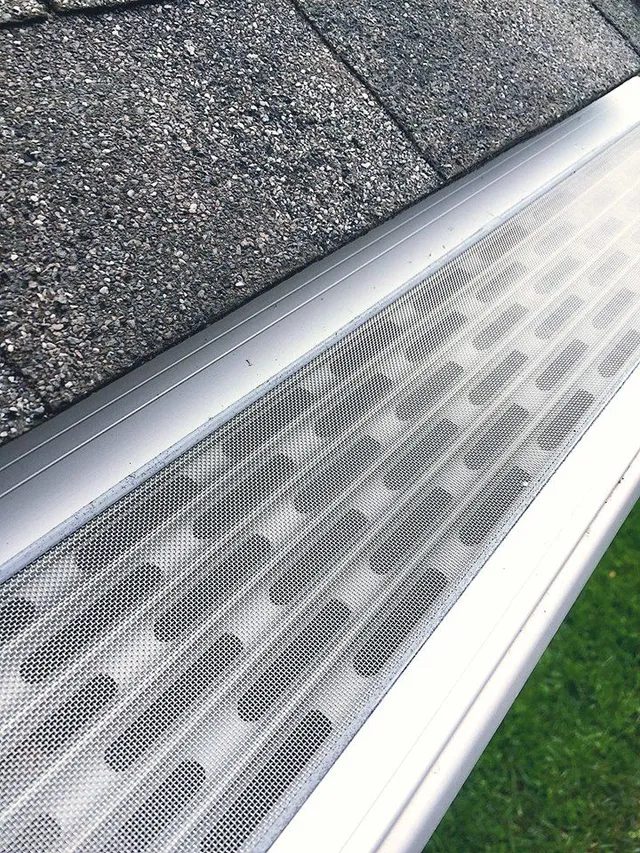
Clean too early and you'll pay to do it twice. Pin oaks in this metro hang onto leaves into December some years, and a gutter cleared on the first of November will be packed again by Thanksgiving under one of them. The usable window is after the drop and before the ground locks up, which around St. Louis generally means the last ten days of November through mid-December.
With a big oak or a pine over the roof, plan on two passes and budget for it. Pine needles are their own category of nuisance. They're fine enough to slip past a coarse screen, they mat flat into the bottom of the trough, and they hold water there like a sponge all winter. Our fall cleaning page covers the two-pass timing in more detail.
Downspouts, extensions and the frozen slab
A downspout emptying onto a splash block two feet off the wall is harmless in July and a real hazard in January. Water spreads across frozen ground instead of soaking in, refreezes as a sheet, and builds up against the foundation and out over the walk. On a clay lot that ice is sitting exactly where you least want water to be.
Extensions that carry the flow six to ten feet out handle most of it. Where we've buried solid pipe to a pop-up emitter, we check the emitter is open before winter and we talk honestly about whether a shallow line is going to freeze shut. A buried line with no fall and no cleanout backs up in February, and then the downspout above it backs up too. More under downspout drainage and water at the foundation.
Ice dams: what gutters do and don't cause
Gutters take the blame for ice dams and they're mostly innocent. A dam forms because heat escaping into the attic melts snow up the slope, the meltwater runs down to a cold eave, and it refreezes where there's no heat under it. The gutter is where that ice collects, not the reason it formed. Cleaning a trough won't stop a dam on a house with a warm attic.
What a clean, draining gutter does do is keep meltwater from pooling and backing up under the shingle edge, and that's worth the visit. The cause is an insulation and ventilation problem, which our ice dam page works through. If somebody tells you a gutter guard prevents ice dams, be skeptical and ask them why.
What a winter prep visit covers
Clear the trough
Debris out by hand, outlets and elbows flushed through.
Learn moreFlow test and repair
Water in one end, and a fix for anything that holds.
Learn moreRe-pitch and rehang
Low runs brought back to fall before ice loads them.
Learn morePush the water out
Extensions and conductors that get water away from the wall.
Learn moreCheck the wood
Soft fascia found now instead of in an ice storm.
Learn moreGuards, if they fit
Cover recommended only where the tree load justifies it.
Learn more
Three things we won't sell you for winter
Heat cable as a default. It has a narrow place, on a chronic problem eave where the attic genuinely can't be fixed, and it's an electric bill plus a consumable that fails in a few seasons. On a house where the real repair is available, we'd rather do the real repair.
A guard installed in December on a gutter nobody cleaned first. Whatever is left in the trough is now sealed under a cover for the winter, and you've paid to trap it there.
Pressure-washing a trough in freezing weather. It looks thorough. What it actually does is drive water into open seams and behind fascia days before a hard freeze. Hand-clear, flush with a hose, move on.
One more thing worth saying plainly: if the pitch is off, a cleaning is a stopgap. We'd rather rehang the run in November than come out to pick it up off the driveway in February. Deciding which one you need is what repair versus replace is for.
Winter gutter questions people ask
When is it too late to clean gutters for winter?
Not until there's ice in them. Any time before the trough freezes beats waiting for spring, and we run cleanings straight through December most years. Once a run holds a solid block of ice we stop, because chipping it out wrecks the seams.
Should the downspouts come off for the winter?
No. The trough has to drain during every thaw, and an open outlet with nothing under it dumps straight against the wall. Leave them on, and make sure the bottom elbow and any extension are clear.
How can I tell my gutters are holding water without getting on a ladder?
Look at the front edge from the driveway after a rain. A run that's holding sags in the middle and the front lip tips outward. Stains streaking down the fascia and a drip line in the mulch directly under the trough are the other two giveaways.
Do you work in the cold, or is this a spring job?
We work all winter. Sealant behaves differently below about forty degrees so we pick product for the temperature, and a gutter hanging off a corner after an ice storm doesn't wait until April. The phone is answered at any hour, holidays included.
Is winter a bad time to replace gutters?
It's a fine time, and getting on the schedule is often faster. Aluminum is formed cold, so the metal doesn't care what month it is. We watch the forecast for ice on ladders, and we won't start a tear-off with freezing rain coming in.
Where we do this work
St. Louis · Kirkwood · Webster Groves · Florissant · St. Charles · Edwardsville
Book a winter prep visit
Tell us how many stories and whether there's a big oak over the roof. That sets the scope.
More on winter and water
A St. Louis gutter company that answers in January
Family-run since 1947, third generation, BBB A+, with live phone coverage 24 hours a day.