
Copper that's still doing its job
Houses between Kingshighway and Euclid often still carry the copper that went up when they were built. It has outlasted three roofs. Copper doesn't rust, it work-hardens, and it gives out at the joints, so what we find is almost never a hole in the middle of a length. It's an opened solder seam, a slip joint with no expansion room left, or an outlet soldered stiff until the trough tore itself at the corner.
All of that is repairable. A sound seam gets cleaned and re-soldered, not smeared with sealant. Caulk on copper lasts about two winters, because the joint keeps moving and the bead doesn't.
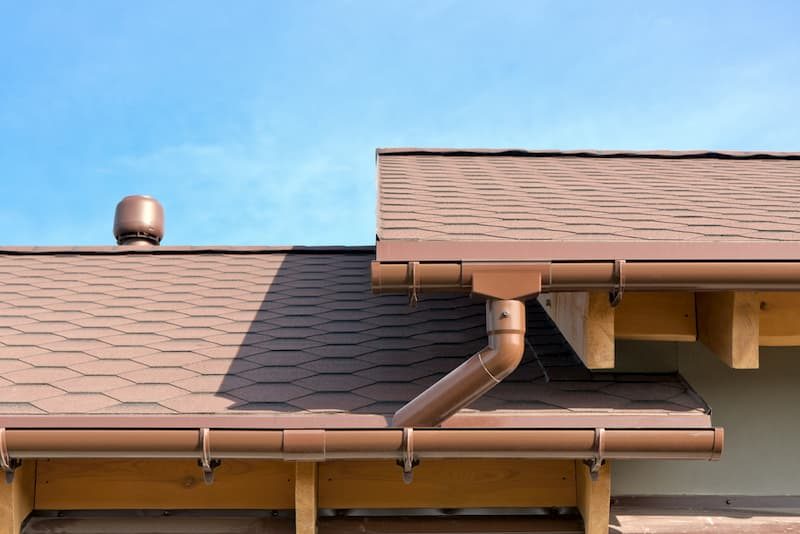
Where a run is genuinely finished we'll price copper going back, and we'll price a painted aluminum half-round beside it that reads close from the street for a lot less. Both are honest numbers. Which one is right depends on the elevation and what you intend to do with the building.
Slate, tile, and staying off the roof
Nobody should be walking a hundred-year-old slate roof to reach a gutter. A crew that does will cost you more in broken slate than the gutter job is worth. We work these elevations from ladders and staging, off a flat rear roof when the building has one, with jacks and padding only where there's no other route up. Tile is less forgiving still, because a cracked tile doesn't announce itself until the next rain.
That's slower, and the estimate says so. Twenty feet of front on a three-story is not the same job as twenty feet on a ranch, even though the linear footage matches. Anybody pricing it by the foot alone hasn't actually looked at the building.
Built-in troughs behind the cornice
A fair share of these buildings drain into a wooden trough framed into the roof edge instead of a gutter hung on fascia. The first sign of failure is a stain at the top of an interior wall, and the first guess is nearly always the roof. We put water in the trough and watch where it comes out before anybody prices anything.
If the decking under the lining is sound, the answer is a continuous liner carried through the corners and into the conductor head. If it isn't, there's carpentry ahead of the metal and the number moves accordingly. We'll also tell you when the trough is fine and the real leak is a failed flashing six feet away, which happens more than you'd think.
Downspouts in a gangway
Between two brick three-stories there's often four feet of concrete and a shared fence line, and that's exactly where the water ends up. A downspout dumping into a gangway that pitches back toward the wall is a basement problem with a roof cause. It's common enough around here that we go looking for it before the homeowner brings it up.
Choices are limited but they're real: carry the discharge through to the rear yard, tie into an area drain we've proven is open, or run solid pipe under the walk out to the alley. What we won't put in is flexible corrugated pipe under a gangway. It crushes under the slab, it holds sediment, and nobody can snake it afterward.
What we take on in the CWE
Solder repair
Seam soldering, new copper trough and round conductors.
Learn moreHalf-round replication
Bracket-hung and sized to the elevation.
Learn moreDropped miters
Torn outlets and seams, seams weeping into masonry.
Learn moreBuilt-in clean-out
Troughs cleared by hand and conductors flushed.
Learn moreCornice and wood
Soft framing addressed before metal goes back.
Learn moreFlats and mixed use
Parapet buildings with internal drainage.
Learn more
Shortcuts we don't take here
Painting copper. People ask, usually because a previous owner painted some of it already. Paint peels off copper within a couple of seasons and then somebody is paying to strip it. Leave the patina alone, or replace the bad section in kind.
Hanging K-style across an ornamental cornice because it's cheaper by the foot. On some houses nobody would notice. On a stone-fronted three-story with brackets under the eave you'll see it from the sidewalk every day for thirty years. Our Lafayette Square page covers the same argument on a different housing stock.
Screwing aluminum gutter into a masonry frieze with no wood behind it. A hanger needs something to bite. When there isn't any, that's a carpentry conversation, not a gutter conversation, and pretending otherwise puts the run on the ground in a year.
We also won't quote copper we can't get on a sensible schedule. If the lead time is long, you get the number and the date in the same sentence. The rest of our service list is on our main St. Louis page.
Central West End gutter questions
Can you re-solder copper instead of replacing the run?
Most of the time, yes. Copper rarely fails in the middle of a length; it opens at a soldered seam, at a slip joint that lost its expansion room, or at an outlet that was soldered rigid and tore at the corner. A clean joint gets re-soldered. Caulk on copper is a tell that somebody didn't want to run a torch.
Do we need historic approval in the Central West End?
Parts of the neighborhood sit inside local historic districts with their own standards, and several private streets have trustees with a say as well. Putting the same profile back in the same material is the smoothest path. We flag it during the estimate rather than after material is ordered.
Is painted aluminum half-round a real substitute for copper?
It's a legitimate answer at a fraction of the cost, and from the sidewalk it reads close. What you give up is life expectancy and the patina. On a rear elevation nobody sees, we'll often recommend it ourselves. On a street-facing stone front, think harder.
Water is staining the top of an interior wall. What does that usually mean here?
On these buildings it points at a built-in trough behind the parapet more often than the roof field. We run water into the trough and watch where it goes before pricing anything, because a wrong guess here is expensive carpentry.
Will you work on a four-unit building on Westminster?
Yes. Plenty of these are flats now. The metal work is identical and the access conversation is longer. We keep one point of contact, and we put photographs of what we found in writing so an owner who lives elsewhere can see it.
Nearby neighborhoods
St. Louis · Lafayette Square · The Hill · Clayton · University City · Ladue
Free estimate in the Central West End
Tell us what the stain looks like and which floor it's on. We'll come read the roofline.
Related reading for masonry homes
A St. Louis gutter company that solders instead of caulking
Third generation, family-run since 1947, Owens Corning Platinum Preferred, answering the phone at any hour.