
The cornice is the constraint
On a plain ranch the fascia is a flat board and a hanger bites it anywhere along its length. Here the roof edge is a built-up assembly: a crown, a frieze, brackets carved or turned, sometimes a shallow gutter integrated into the profile itself. Every one of those pieces is doing something, and a hanger driven through the wrong one splits it.
So the sequence changes. We figure out what's structural and what's ornament before anything is fastened, then hang from the sound member and work around the rest. Brackets for half-round get spaced tighter than most crews assume, closer to two feet than three, because a round trough carrying water and a February ice load will roll out of a loose bracket.
We see plenty of houses where a previous contractor took the fast route and screwed a modern gutter straight across the bracket faces. You can spot it from the sidewalk. The trough sits proud of the cornice line, the shadow is wrong, and behind it there are twenty screw holes in trim nobody makes anymore. Some of that we can patch. Some of it a carpenter has to rebuild, and that's a conversation we'd rather have honestly at the estimate.
Copper, and when we tell people not to buy it
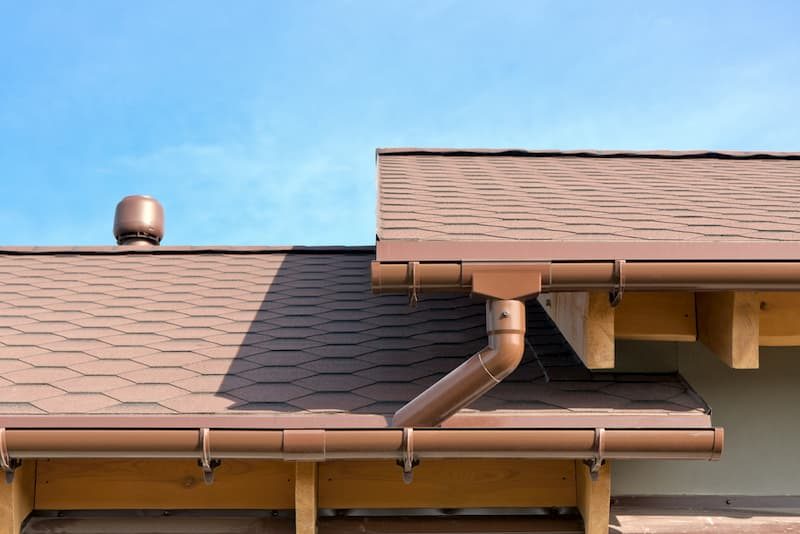
Copper belongs on a certain kind of house. Heavy gauge, soldered joints, round conductors on decorative straps, and thirty or forty years of service without a coating to fail. On a restored Victorian with an intact cornice it looks like it grew there, and it's one of the few materials that keeps looking better as it ages.
It's also several times the cost of painted aluminum, it wants soldered corners rather than sealant, and it will never patina evenly on a house where the south face bakes and the north face stays shaded. If somebody wants a uniform green roofline in five years, copper won't deliver that and we say so before the deposit. Painted aluminum half-round in a dark bronze reads correctly from the street at a fraction of the number, and we hang a lot of it here for exactly that reason. Our page on copper gutters lays out the trade-offs in more detail.
Three stories of ladder, one narrow lot
Access here looks like Soulard's: no meaningful side yard, an alley behind, and a front elevation that runs up past thirty feet to the cornice. Ladder work at that height over a brick walk is slow by necessity, and on the tallest rear walls we set staging rather than trying to reach it.
That's a real line in the estimate and we'd rather explain it than pad the per-foot price to hide it. It also explains why we push people toward doing everything at once. If the crew is already staged on the north elevation, clearing the trough, resealing the outlet and wrapping a soft section of fascia in the same visit costs far less than three separate trips.
Water, clay and the walk out front
The lots around the park are flat and the soil under them is the same expansive St. Louis clay that gives half this city bowed basement walls. A downspout emptying at the base of a hundred-fifty-year-old brick foundation is doing steady damage nobody sees for a decade.
On these lots there's often nowhere obvious to send the water, so we get creative within reason: buried solid PVC to an emitter at the front edge of the yard, a tie-in to an existing area drain once we've proven it's open, or a run to the alley. What we avoid is discharging across a public sidewalk, because that turns into a sheet of ice the first cold night in January. There's more on the mechanics in what roof water does to a foundation.
What we do on Lafayette Square houses
Half-round installation
Bracket-hung aluminum or copper half-round with round conductors.
Learn moreCopper work
Soldered corners, heavy-gauge trough, decorative straps.
Learn moreRepair around trim
Leaking corners and outlets addressed without tearing up the cornice.
Learn moreColor matching
Baked-enamel finishes chosen against the trim, not against a brochure.
Learn moreFascia and soffit
Rot cut out and rebuilt before new metal is hung on it.
Learn moreCleaning at height
Hand-cleared troughs on three-story elevations, conductors flushed.
Learn more
Where we say no
Guards on ornamental half-round. Most covers are engineered for K-style, and forcing one onto a round trough either looks wrong from the street or traps debris under the edge. On a house under heavy canopy we'd rather put you on a twice-a-year clearing schedule than sell hardware that spoils the roofline.
Aluminum fastened to copper. Two dissimilar metals in wet contact corrode, and the joint fails years before either material would have on its own. If the budget is copper on the front and aluminum around back, we isolate them and run separate systems.
A full replacement when three corners and an outlet are the actual problem. Plenty of these houses have gutter with real life left in it and a couple of failure points that a half-day fixes. If that's what we find, that's what we quote. Our repair-or-replace guide walks through where the line sits.
Lafayette Square gutter questions
Will half-round handle as much water as K-style?
Not foot for foot. A 6-inch half-round moves roughly what a 5-inch K-style does, so on a big Victorian roof we size up or add an outlet rather than pretending the profile doesn't matter. That's a measurement, not a preference.
How long before copper turns green?
Slower than most people expect in this climate. It darkens to brown in the first couple of years and the green patina takes considerably longer, and it never arrives evenly on a house that gets sun on one face and shade on another. If you want uniform, copper is the wrong material.
Can you hang gutter without damaging the cornice brackets?
That's the whole job on these houses. We hang off the fascia or the roof edge and work around ornamental brackets rather than through them. Where an earlier crew screwed straight into decorative trim, we patch what we can reach.
The mansard has no gutter at all. Should it?
Sometimes the design never called for one, and adding a trough to a steep mansard face creates problems it doesn't solve. What matters is what the upper roof does with its water and where that lands. We'd look at the whole path before quoting metal.
Do you mix copper and aluminum on one house?
We'll do it when the budget says front elevation only, and we're upfront that the two will never look like a set. What we won't do is run copper into an aluminum downspout or fasten one to the other, because dissimilar metals in contact corrode.
Neighborhoods next door
Soulard · Tower Grove · St. Louis · Clayton · University City · Webster Groves
Free estimate in Lafayette Square
Send us the elevation that's leaking. We'll look at the trim before we quote metal.
More on profiles and materials
A St. Louis gutter company that respects old trim
Third generation, family-run since 1947, with a lifetime workmanship warranty behind the install.