
Two pieces of gutter, one awkward angle
Seamless gutters can run forty or fifty feet with no joint, but they can't turn a corner. Wherever the roofline changes direction, somebody has to join two pieces. On a simple ranch that's four outside corners. On a two-story with a couple of bump-outs and a porch it can be a dozen or more, inside and outside.
Every one of those is a joint. And a joint is the one place on a seamless gutter where water has a built-in chance to get out.
That's why we spend more time on corners than on any straight run.
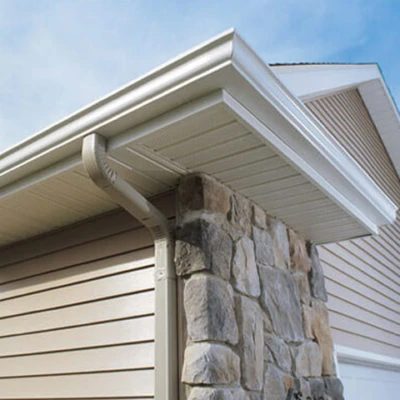
How a strip miter is put together
The installer cuts each gutter end at roughly forty-five degrees, butts them together and lays a strip of matching aluminum across the seam on the inside and along the bottom. Pop rivets pin it in place. Gutter sealant goes along the inside of the joint, over the rivet heads and down the strip edges.
Done slowly, with clean metal and the right sealant, it's a solid corner. Done fast, with a gap at the cut and a bead of caulk smeared over the top to hide it, it'll start weeping within a couple of seasons.
Box miters and their trade-offs
A box miter is a formed corner piece. The gutter ends tuck inside it and get riveted and sealed at both seams. The corner shape is one solid piece, which leaves less sealant exposed in the worst spot.
The catch is you now have two seams instead of one, one on each leg. They sit a few inches back where less water piles up, which is the whole idea. Box miters also need the gutter profile and size to match the piece exactly, so they don't suit every odd angle a hip roof throws at you.
Inside corners carry the heavy load
An inside corner sits under a valley, where two roof planes pour into one line. In a summer cloudburst that valley pushes a sheet of water straight into the miter. Leaves and maple seeds ride along with it and settle right at the joint.
So the inside corner is under water more often and under debris more often. If it's a strip miter with tired sealant, it's the first place you'll find a drip line on the siding. A splash guard on the outer edge helps keep the valley's water from shooting over the top.
What freeze-thaw does to a corner
Aluminum grows and shrinks with temperature. A long run on the south side of a house moves a noticeable amount between a January night and an August afternoon, and that movement gets pushed into the corners.
Our winters swing above and below freezing again and again. Water that gets into a hairline gap freezes, opens it a bit more, then thaws. After a few seasons, sealant that was fine on day one has pulled loose along one side of the joint. It's why we'd rather reseal a corner properly than smear new caulk over the old bead.
Resealing versus replacing a corner
If the metal is sound, a leaking strip miter can usually be fixed. We strip the old sealant, clean the joint down to bare aluminum, replace loose rivets and seal it again. That's a small repair, and on a gutter that's otherwise straight it's the right one. Our page on a gutter dripping at the corner walks through finding the exact source.
When the corner is bent, the cut was never close, or there's corrosion around the rivets, we cut it out and build a new miter. That might be a box miter if the profile allows. Either way we'll show you what we found before we price it.
Corners on old brick and on newer builds
On older brick two-stories in south city, corners are often where an old four-inch gutter got spliced to a newer piece decades ago. The joints are mismatched, and the brick under them shows the stain. On newer St. Charles builds the gutters were frequently hung in thin .019 coil, and those corners flex whenever someone sets a ladder near them, cracking the sealant.
Different houses, same symptom. The repair is different for each, which is why we look before we quote. Joints in the middle of a run are another matter, covered under leaking gutter seams.
Where corners fit in the bigger picture
Fewer joints on long runs
Why one long piece leaves only the corners to watch.
Seamless gutters vs sectional →Support near the corner
A hanger close to each miter keeps the joint from flexing.
Gutter hangers explained →The drop beside the valley
Inside corners often need the bigger downspout.
2x3 vs 3x4 downspouts →
Corner work we would turn down
Replacing an entire gutter system because two corners drip. A reseal or a new miter costs a fraction of that.
Covering a leaking miter with a peel-and-stick patch. It looks fixed for a month. Then water finds the patch's edge.
Box miters forced onto a roof angle they weren't made for. A carefully built strip miter is the better corner there, and we'll tell you so.
Questions about miters and corner joints
Which is better, a strip miter or a box miter?
Neither wins everywhere. A box miter keeps sealant out of the exact corner but adds a second seam. A strip miter fits any angle. Built carefully with clean metal and good sealant, both hold up well.
Why do my gutters leak at the corners and nowhere else?
On a one-piece gutter system the corners are usually the only joints, so they're the only place water can escape. Aging sealant, a gap at the cut or debris backing water up at an inside corner are the usual causes.
Can I reseal a gutter corner myself?
On a single-story house with a steady ladder, plenty of homeowners do. Remove all the old sealant, clean to bare metal, let it dry and use a sealant made for gutters. Caulk spread over old caulk rarely lasts.
How often do gutter miters need resealing?
It depends on the sealant, the sun and how much water the corner takes. Inside corners under valleys usually need attention first. Look them over each fall while you clean, and reseal at the first drip line.
Do half-round gutters use the same kind of corners?
They use their own formed corner pieces sized to the half-round profile, joined and sealed at each end. The same rules hold: clean joints, good sealant and extra attention to inside corners under valleys.
Corner leak or new gutter estimate
Tell us which corner is dripping, inside or outside, and about how high it is off the ground.
Tight corners from a St. Louis gutter company that answers
Three generations of Beals have run this company, and it's been family-owned since 1947. Our phones are answered live around the clock. You'll find us rated A+ with the BBB, listed as an Owens Corning Platinum Preferred contractor and named to Roofing Contractor Magazine's Top 100. A lifetime workmanship warranty comes with the work, and the estimate is free.