
Four-inch trough on a hundred-year-old flat
The original gutter on many of these buildings is 4-inch, which was the standard when they went up and is undersized for the way rain arrives now. A brick two-story with a small roof area can live with it. Put a two-story addition on the back or a dormer on the side and that same trough is draining half again as much water, and it spills at the corner every time a cell parks over the south side.
We measure the roof before arguing about size. If the math says 5-inch with a bigger outlet, that's the quote. If 4-inch is genuinely adequate and the actual problem is a dropped miter, we fix the miter and charge you for a miter. Selling somebody a size they don't need is a good way to never work on the block again.
Hangers matter more than the metal on these houses. Cornice wood on an 1890s flat is often original fir, hard as iron in places and punky in others. A screw into a punky spot holds for one winter. So we probe for solid backing, and where the spacing has to shift to catch it, we add a hanger rather than stretching the gap.
Brick, mortar, and water running down a wall
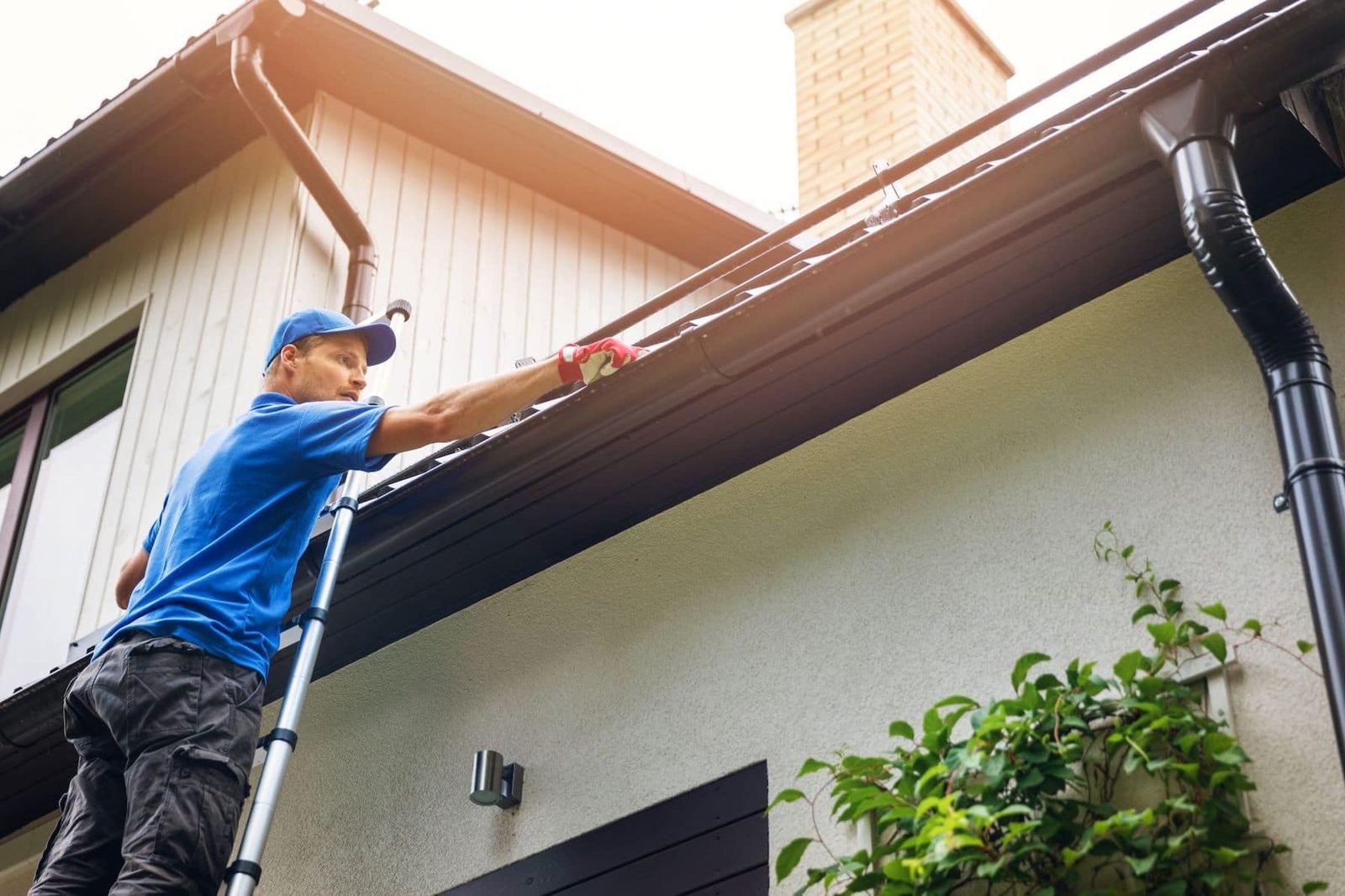
When a gutter tips outward on a brick building, the water sheets down the face and into the mortar joints. South-city brick is soft and the original lime mortar is softer, and forty years of that produces a wall that spalls and drops face brick into the gangway. Freeze-thaw does the actual work. Water soaks into the joint through a warm afternoon, freezes overnight, and pushes.
On these buildings the gutter isn't trim, it's what keeps the wall dry. We'd rather repair a run properly this year than watch a homeowner defer it into tuckpointing money. We don't do masonry ourselves, and when the wall needs a mason regardless of what we do with the metal, we say that instead of pretending new gutter fixes it.
No side yard, one alley
Most of these lots are twenty-five feet wide with the building filling nearly all of it. There's a gangway too tight to set a ladder in without hitting the neighbor's wall, an alley behind, and a public sidewalk in front. That geometry drives the whole approach, and it's why two buildings that look identical from the street come back with different numbers.
We set from the alley where we can and from the sidewalk where we have to, with a neighbor's permission when the only safe footing is on their concrete. That last part is worth asking about early. It costs a phone call, and it's a lot cheaper than bringing in staging.
Oak tassels in May, acorns in September
Street trees through here are mixed, but wherever there's a big pin oak the gutters get hit twice a year on a schedule you could mark on a calendar. Tassels come off in May, fine and stringy, and they mat into a felt that water simply sits on. Acorns arrive in September and plug an outlet outright.
That pattern is why we push two cleanings a year on oak-heavy blocks, and why we're cautious about fine screens under one. Tassels are precisely the debris that blinds a mesh from above. We'll walk the roofline and tell you which elevation wants a cover and which one doesn't, instead of wrapping the whole building and calling it solved.
Benton Park work we take
Reseal and re-pitch
Open seams, dropped miters, outlets torn at the corner.
Learn moreHalf-round put back
Brackets and round conductors.
Learn moreTwice-a-year clearing
Hand-cleared trough, flushed outlets, photos of the debris.
Learn moreWhere water discharges
Flow moved off the walk and away from the wall.
Learn moreCornice repair
Punky fascia and framing replaced before new metal.
Learn moreWater behind old metal
Where it gets in old metal and into brick.
Learn more
What we'd talk you out of
Replacing everything when three sections are fine. We sell repair more often than replacement in Benton Park, and the invoices are smaller for it. Deciding between the two is what this page is about.
Spike-and-ferrule hangers driven back into old cornice wood, even though they're quick and the holes are already drilled. Every one of those holes is the reason the gutter is loose today.
Corrugated flex pipe down a gangway or under a walk. It crushes, it silts up, and the first time it backs up somebody is breaking concrete to find out why.
And a guard on a 4-inch trough that's already at capacity. Covering a gutter that overflows doesn't stop it overflowing. Now it just does it where you can't see the cause. Neighboring blocks run into the same thing, which our south city page gets into.
Benton Park gutter questions
Do you repair old half-round, or does all of it have to come off?
Often it's repairable. Half-round hangs on brackets, so a failed bracket, a split at a joint or a dropped section can be dealt with on its own. When the metal is pitted through along the bottom of the trough, that length is finished and we'll say so plainly.
The back of our building is flat with a parapet. Is that gutter work or roof work?
Both, and the trough is the dividing line. We clear and line built-in troughs and we handle the conductor below them. If the membrane on the flat itself is failing, that's a roofing crew, and John Beal Roofing has those too.
Our gutter runs continuous into the neighbor's. How do you handle that?
Carefully, and with a phone call first. Runs crossing a party wall are normal on these blocks. We can cut and cap at the wall with a proper end so your side drains by itself, or coordinate the work if both owners want it done at once.
Can you get a truck down the alley?
Usually. When we can't, we park at the curb and carry. The run-off machine forms trough at the truck, so a tight alley isn't a reason to skip a job or charge extra for one.
We're mid-rehab. When should the gutters go on?
After the masonry and the roof, before the paint. New metal goes up late so nobody dents it with staging, and the painter gets to cut a clean line against a finished edge.
Around Benton Park
Soulard · South City · Tower Grove · The Hill · Affton · St. Louis
Free estimate in Benton Park
Tell us which elevation spills and whether there's a gangway. That changes the ladder plan.
Related reading for old brick
A St. Louis gutter company that knows south-city brick
Family-run since 1947, third generation, lifetime workmanship warranty, phone answered day and night.