
Reading the stain on the wall
Mildew from a gutter has a shape. It runs in a band straight down below the gutter edge, widest at the top, and it's darkest on walls that don't get afternoon sun. Look at the north and east sides first. That's where siding stays damp longest after a storm.
On vinyl it shows up as a gray-green film you can smear with a finger. On painted wood trim it's black speckling, often under a window head where the drip lands. Brick gets a green cast low on the wall and a white crust higher up. The white stuff is efflorescence, salt pulled out of the masonry as water dries, and it means the brick has been soaking.
If the band lines up with a gutter corner, a seam or the stretch where a big tree hangs over, you've found your source.
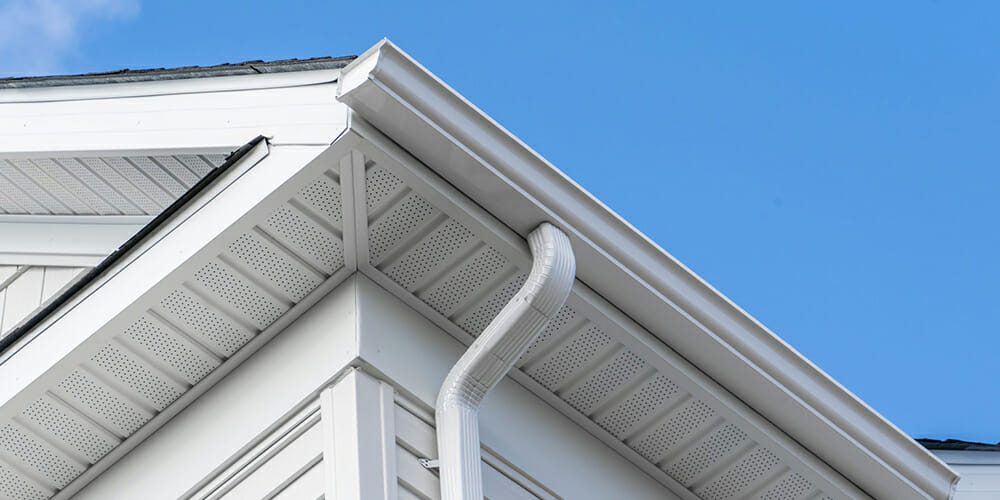
Why one wet strip turns green
Mold spores are on every wall in the city. They don't do much on a surface that dries out in an afternoon. Overflow changes that, because it hits the same few feet of wall in every rain and keeps them wet into the next day. Add July humidity and a shade tree, and you've built a greenhouse for it.
It's one of the most common calls our St. Louis gutter company gets from homes on shaded lots. The soil plays a part too. St. Louis clay doesn't drain, so water that sheets off a gutter lands at the foundation and sits. The bottom course of siding stays damp from below as well as above.
The kind on the siding and the kind you can't see
Growth on the outside of the house is mostly a looks problem. It's ugly, it stains, and it can be scrubbed off. We don't panic about it.
The expensive version happens out of sight. When water gets behind a gutter instead of over it, it soaks the fascia and can wick into the roof deck at the eave. Homeowners find it as dark sheathing in the attic along an outside wall, or a musty basement corner right where a downspout empties against the foundation. If you're seeing mildew indoors, start with our page on water getting behind the gutter, because that fix is different from a plain overflow.
Old brick needs a gentle hand
A lot of south city houses are soft red brick laid in lime mortar a century ago. That brick drinks water. Years of overflow leave it green at the base and crumbly at the joints, and every freeze-thaw cycle pops a little more of the face off.
Please don't take a pressure washer to it. High pressure cuts into old mortar and the face of soft brick, and you can do more damage in ten minutes than the algae did in ten years. A low-pressure rinse, a soft brush and a cleaner made for masonry is the right approach. Only do it after the water above is under control.
Tracking it back to the gutter above
Once we've matched the stain to a stretch of gutter, the cause usually lands in one of four buckets.
- A clog. Oak tassels in May and silver maple seeds in spring pack into the trough and dam it, often just upstream of the downspout outlet.
- A belly in the run. A hanger lets go, the gutter dips, and water pools in the low spot until it spills over the front.
- A downspout that can't keep up. One small 2x3 draining a big roof plane will back up in a hard storm.
- Roof water shooting past the gutter. A valley can throw water over the lip and onto the wall below in a downpour.
Our overflowing in one spot page walks through each of these in more detail.
Fix the water, then wash the wall
The order matters. Scrub a wall that's still getting soaked and the growth is back by next summer, sometimes sooner. So the first visit is about the gutter: clean it, re-pitch the low stretch, reseal the leaking joint or add a downspout where one is overloaded.
After that the wall can be cleaned and left to dry out properly. Give it a full season. Light staining on brick sometimes fades by itself once nothing is feeding it.
If the wall is only part of it
What we won't sell you for mildew
Mold remediation. If there's growth inside your walls or attic, you need a remediation contractor, and we'll tell you so. Our job is stopping the water that feeds it.
A whole new gutter system over a green stripe on the siding. If one corner or one clogged outlet is the cause, that's what gets fixed.
A clear sealer brushed over old brick to keep water out. On soft brick that can trap moisture in the wall and make spalling worse. Keeping water off the brick works better.
When a downspout dumps at the foundation, a longer extension or a better outlet often does more than anything else. See downspout not draining if water backs up at the bottom, and loud gutter dripping if the same low spot keeps you up at night.
Questions about mildew under gutters
Is the green stuff on my siding mold or algae?
Often it's algae, sometimes mildew, and usually both. For a homeowner the difference doesn't matter much. Either one is telling you that strip of wall stays wet, and the gutter above it is the place to look.
Will the mildew go away once the gutter is fixed?
It stops spreading, but most of what's already there has to be cleaned off. Light growth on brick sometimes fades over a season or two once it dries out. Heavy staining on vinyl or painted trim needs a gentle wash.
Can gutter overflow cause mold in the basement?
It can. Water that spills at the foundation soaks the clay around it, and the basement wall behind that spot can turn damp and musty. Moving the water well away from the house usually helps more than anything done inside.
Should I pressure wash mildew off brick?
Not on older brick. High pressure erodes soft brick and lime mortar. Use low pressure, a soft brush and a masonry-safe cleaner, and wait until the gutter problem above has been fixed.
Do gutter guards stop mildew on the walls?
Only if a clog was causing the overflow. A guard keeps leaves and seeds out of the trough. It won't fix a low spot, a leaking joint or a downspout that's too small for the roof draining into it.
Tell us where the wall stays wet
Which side of the house, roughly how wide the stain is, and whether it's on siding, brick or trim.
A St. Louis gutter contractor for wet, stained walls
We've been a family-run roofing and gutter company since 1947, and the third generation runs it today. BBB A+ rated, a Roofing Contractor Magazine Top 100 company, with a lifetime workmanship warranty. Estimates are free. A real person picks up 24/7.